
TL;DR:
- Strategic advisory services guide organizations in making long-term decisions related to growth, governance, and risk management. These services focus on shaping organizational vision and are distinct from operational consulting, which addresses short-term problems. Effective advisory integrates practical implementation support and measurable governance frameworks to ensure sustainable results.
A strategic advisory service is a professional consulting engagement that guides organizations through long-term, high-level decisions including business direction, financial structuring, and risk management. Unlike operational consulting, which solves immediate problems, strategic advisory focuses on vision, growth strategy, governance, and organizational sustainability. Business leaders working through market expansion, M&A activity, or succession planning rely on these services to make decisions with confidence and clarity. Understanding what is strategic advisory service, and how it differs from other consulting types, is the first step toward using it well.
What is strategic advisory service and what does it cover?
Strategic advisory services guide organizations in long-term, complex decisions that shape competitive positioning and institutional resilience. The scope goes well beyond fixing a broken process or improving a quarterly metric. Advisors work at the level of vision, market positioning, and governance.
The core service areas within strategic advisory typically include:
- Growth strategy development. This covers market entry, geographic expansion, and product diversification. Advisors analyze client-specific market dynamics to build plans that are executable, not theoretical.
- M&A due diligence and integration support. Advisors assess acquisition targets, model deal structures, and design post-merger integration plans.
- Succession planning and leadership transition. This protects organizational continuity when founders, CEOs, or key executives step back.
- Governance structuring and risk management. Advisors build frameworks that help boards and executive teams monitor strategic alignment over time.
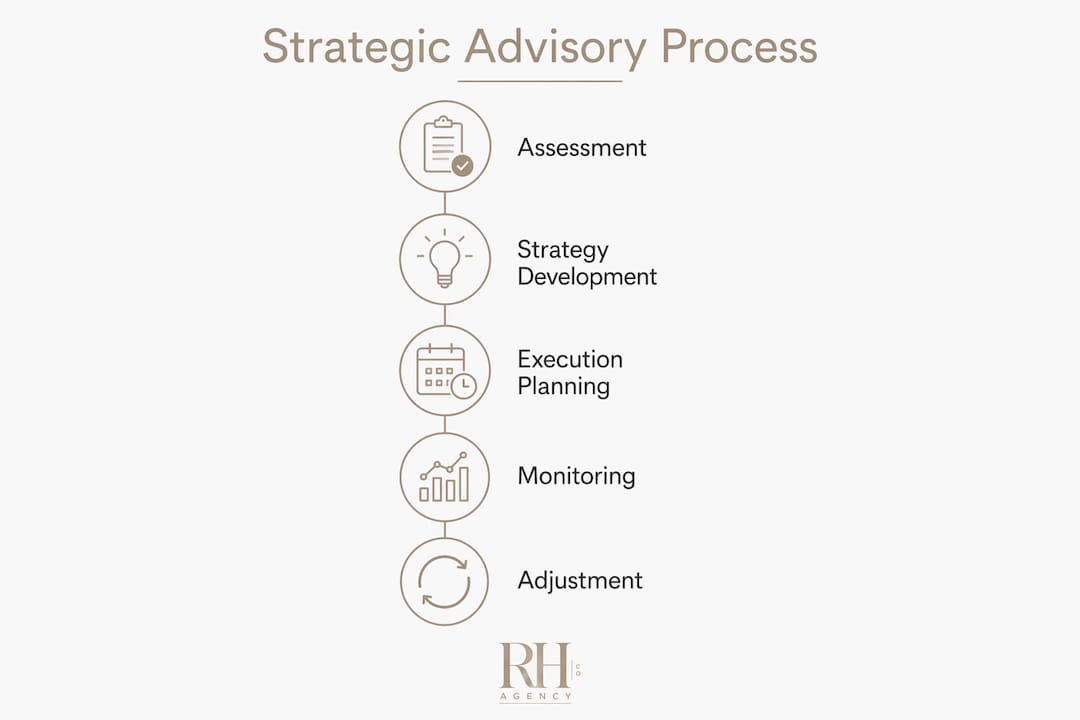
The engagement process follows a clear sequence. Advisors begin with an organizational assessment, then develop a strategic roadmap, move into implementation design, and close with performance measurement frameworks. Each phase builds on the last. The goal is a plan the leadership team actually owns and can execute.
Pro Tip: Bring your advisory team in during the assessment phase, not after you have already decided on a direction. Early involvement produces plans that reflect real organizational constraints, not just ideal scenarios.

How does strategic advisory differ from other consulting?
The clearest distinction is time horizon and scope. Operational consulting solves a defined problem within a defined timeframe. Strategic advisory shapes how an organization thinks and decides over years. High-value advisory improves the quality of leadership thinking and builds consensus so that management owns execution, not just the advisor.
Here is how the two approaches compare across key dimensions:
| Dimension | Strategic Advisory | Operational Consulting |
|---|---|---|
| Time horizon | Long-term, multi-year | Short-term, project-based |
| Primary focus | Vision, governance, growth | Process improvement, execution |
| Deliverable | Strategic roadmap, governance framework | Report, tactical solution |
| Role of advisor | External strategic board | Project executor |
| Decision type | Complex, non-transactional | Defined, transactional |
A few distinctions that often get overlooked:
- Strategic advisors do not replace your leadership team. They sharpen how that team thinks and decides.
- Financial advisory focuses on capital structure and transactions. Strategic advisory integrates financial considerations into a broader organizational direction.
- Implementation design is built into strategic advisory from the start. Advisors at firms like PA Consulting prioritize practical market and organizational realities over abstract reports.
The result is that strategic advisory produces plans that are both ambitious and executable. That combination is rare, and it is what separates high-quality advisory from a well-written slide deck.
What are the real benefits of strategic advisory services?
The benefits of advisory services extend beyond better strategy documents. Strategic advisory shifts an organization's focus from short-run tactics to institutional resilience. That shift has compounding value over time.
Business leaders who engage strategic advisors consistently report several concrete gains:
- Sharper decision-making. Advisors bring an external, objective perspective that internal teams cannot replicate. They surface blind spots before they become costly mistakes.
- Reduced uncertainty. Structured risk management frameworks give leadership teams a clear view of what they are taking on before committing resources.
- Faster alignment. When advisors facilitate strategy development collaboratively, executive teams reach consensus faster and with stronger buy-in.
- Measurable governance. Quantified, trackable benefits are built into the engagement so boards can monitor progress against strategic objectives.
- Competitive positioning. Advisors with cross-industry experience identify market opportunities that internal teams, focused on daily operations, often miss.
Consider a mid-market company evaluating entry into a new geographic market. Without advisory support, leadership might rely on internal assumptions and move too fast or too slow. A strategic advisor brings market analysis, risk modeling, and governance design to that decision. The company moves with evidence, not instinct.
Pro Tip: Ask any advisory firm you are evaluating to show you how they measure the value they create. Firms that cannot answer that question clearly are selling strategy as a concept, not as a deliverable.
How to leverage strategic advisory services in your organization
Knowing the value of strategic advisory is one thing. Integrating it into how your organization actually operates is another. The practical steps below apply whether you are engaging an advisory firm for the first time or looking to get more from an existing relationship.
- Align on scope before engagement begins. Define whether you need growth strategy, M&A support, governance design, or all three. Misaligned scope is the most common reason advisory engagements underdeliver.
- Engage advisors early in strategy formulation. Proactive engagement supports risk mitigation and aligns vision with measurable governance frameworks before decisions are locked in.
- Build stakeholder consensus through the process. Advisory value multiplies when the full leadership team participates in roadmap development, not just the CEO or board chair.
- Connect advisory recommendations to operational execution. A strategic roadmap without operational support stalls at the planning stage. Executive assistant services, workflow systems, and project management infrastructure are what turn strategy into results.
- Track recommendations against measurable outcomes. Set quarterly checkpoints to assess whether strategic initiatives are producing the results the advisory engagement projected.
The connection between strategic planning and operational execution is where most organizations lose momentum. Strategy without execution infrastructure is just documentation. The leaders who get the most from advisory relationships are the ones who invest equally in the operational capacity to act on what advisors recommend.
Key takeaways
Strategic advisory service delivers lasting organizational value only when it combines high-level direction with practical execution design and measurable governance frameworks.
| Point | Details |
|---|---|
| Core definition | Strategic advisory guides long-term decisions on vision, growth, governance, and risk management. |
| Distinct from operations | Advisory shapes how leadership thinks and decides; operational consulting fixes defined problems. |
| Process matters | Engagements follow assessment, roadmap, implementation design, and performance measurement phases. |
| Benefits are measurable | Advisors build quantified governance frameworks so boards can track strategic alignment over time. |
| Execution requires support | Strategic roadmaps need operational infrastructure to move from planning to results. |
Why most leaders underestimate what advisory actually does
I have worked alongside enough executive teams to notice a consistent pattern. Leaders bring in a strategic advisor expecting a polished presentation with a clear answer. What they get instead, if the advisor is good, is a process that changes how the team itself thinks. That is harder to sell and harder to measure in the short term. It is also far more valuable.
The misconception I see most often is treating strategic advisory as a one-time event. A leader hires a firm, receives a roadmap, and files it. Six months later, nothing has changed. The problem is not the strategy. The problem is that strategy without an execution system is just a document. The best advisory relationships I have observed are ones where the advisor stays connected to implementation, not just ideation.
Bespoke strategies built on client-specific market dynamics outperform template-based approaches every time. That means the right advisory firm asks more questions than it answers in the first meeting. If an advisor arrives with answers before understanding your organization, that is a signal to keep looking.
The other thing worth saying plainly: advisory is not just for large enterprises. Growing businesses with 10 to 100 employees face the same strategic complexity at a smaller scale. The decisions around hiring, market focus, and operational structure are just as consequential. Getting outside perspective on those decisions early is one of the highest-return investments a founder or executive can make.
— Jessica
How the right hand agency co supports your strategic execution
Strategic advisory tells you where to go. The Right Hand Agency Co helps you get there. Once your leadership team has a roadmap, the gap between strategy and results comes down to execution capacity.

The Right Hand Agency Co provides executive assistant services, business operations consulting, CRM implementation, and project management support tailored to small business owners and executives. These services are designed to translate strategic recommendations into daily operational reality without the overhead of full-time hires. If your organization is ready to act on its strategy, The Right Hand Agency Co builds the operational foundation that makes it possible. Explore how operational support for advisors and executives works in practice.
FAQ
What is a strategic advisory service?
A strategic advisory service is a consulting engagement that guides organizations through long-term, high-level decisions including growth strategy, governance, M&A support, and succession planning. It focuses on vision and organizational direction rather than short-term operational fixes.
How does strategic advisory differ from business consulting?
Strategic advisory focuses on long-term direction, governance, and leadership alignment, while business consulting typically addresses defined operational problems within a shorter timeframe. Strategic advisors act as an external board rather than project executors.
What are the main types of strategic advisory services?
The core types include growth strategy development, M&A due diligence and integration, succession planning, and governance structuring. Each type addresses a distinct dimension of long-term organizational decision-making.
When should a business engage a strategic advisory firm?
Businesses benefit most from engaging advisors early in strategy formulation, before major decisions are locked in. Early involvement allows advisors to align vision, assess risk, and design implementation plans within real organizational constraints.
What should i look for when choosing an advisory service?
Look for firms that build measurable governance frameworks, tailor strategies to your specific market dynamics, and include implementation design as part of the engagement. Avoid firms that deliver static reports without connecting recommendations to execution.