
TL;DR:
- Strategic communication aligns messages with organizational goals, audiences, and outcomes intentionally before activities begin. It requires clear message frameworks, audience analysis, deliberate channel choices, and well-prepared spokespeople to build trust and credibility. Organizations that implement it strategically improve influence, internal alignment, and operational resilience, avoiding reactive and inconsistent messaging.
Most executives assume they communicate strategically because they send regular updates, hold all-hands meetings, and have a marketing team. That assumption is costing them. What is strategic communication, really? It is the deliberate alignment of every message your organization sends with a specific goal, a specific audience, and a specific outcome in mind. It is not spontaneous. It is not marketing dressed up in different language. And for business leaders trying to build alignment, trust, and operational momentum, understanding the difference is one of the most underrated advantages available.
Table of Contents
- Key Takeaways
- What is strategic communication, defined
- Why strategic communication matters for organizations
- Strategic communication vs. marketing vs. corporate communication
- How to implement strategic communication
- Organizational structures that support strategic communication
- My take on why most organizations get this wrong
- How The Right Hand Agency Co can help
- FAQ
Key Takeaways
| Point | Details |
|---|---|
| More than marketing | Strategic communication aligns all organizational messages with goals, not just commercial visibility. |
| Measurement drives influence | Teams with aligned KPIs are significantly more likely to secure executive influence and credibility. |
| Message architecture matters | Your messaging must reflect how leaders actually think and behave, not polished aspirational language. |
| Anticipation beats reaction | Strategic communication is integrated into decision-making before problems arise, not after. |
| Structure enables agility | Matrixed team models and feedback loops make strategic communication more responsive and effective. |
What is strategic communication, defined
The definition of strategic communication goes beyond sending the right message at the right time. At its core, it is the practice of intentionally aligning messages with organizational goals before any communication activity begins. A leader who knows their desired outcome before key meetings or messaging is practicing true strategic communication, not improvising.
Four core elements define it:
- Message architecture. A structured, defensible framework of the key ideas your organization stands for and how those ideas connect to your goals.
- Audience analysis. A clear picture of who you are speaking to, what they already believe, and what they need to hear to move in the direction you want.
- Channel strategy. A deliberate choice of where and how messages are delivered, whether through internal briefings, public statements, social platforms, or direct leadership conversations.
- Spokesperson preparation. Ensuring that every person delivering your message is equipped, aligned, and credible.
The strategic communication meaning separates itself from ordinary communication through one thing: clarity of intent. Ad hoc messaging reacts to circumstances. Marketing communication drives commercial visibility. Strategic communication creates a repeatable framework that every function in your organization can use to stay aligned, regardless of the situation.
Why strategic communication matters for organizations
The importance of strategic communication becomes obvious when you look at what happens without it. Employees receive conflicting signals from different leaders. Stakeholders lose confidence when messaging shifts under pressure. Teams waste effort on communication activities that generate noise but no movement.

The data tells a clear story. Only 25% of communication teams meaningfully align their KPIs with broader business goals, based on a 2026 survey of over 800 communicators worldwide. That gap between activity and measurable impact is where most organizations bleed credibility and influence. Teams that close that gap see real returns. Teams with aligned KPIs are up to 10 percentage points more likely to influence leadership and secure executive buy-in.
Beyond leadership influence, strategically anchored internal communication reduces burnout and builds organizational resilience by connecting employees to business priorities rather than leaving them to interpret mixed signals on their own.
Pro Tip: Before your next all-hands or major announcement, write down the single outcome you want the audience to walk away with. If you cannot state it in one sentence, your message is not yet strategic.
Strategic communication vs. marketing vs. corporate communication
This is where a lot of organizations make expensive mistakes. The three disciplines are related but not interchangeable, and confusing marketing with communications can actively harm your strategy.
| Function | Primary focus | Success metric |
|---|---|---|
| Marketing | Commercial visibility and lead generation | Revenue, conversions, reach |
| Corporate communication | Reputation management and stakeholder relations | Trust, media coverage, perception |
| Strategic communication | Narrative alignment across all audiences and functions | Behavioral change, alignment, credibility |
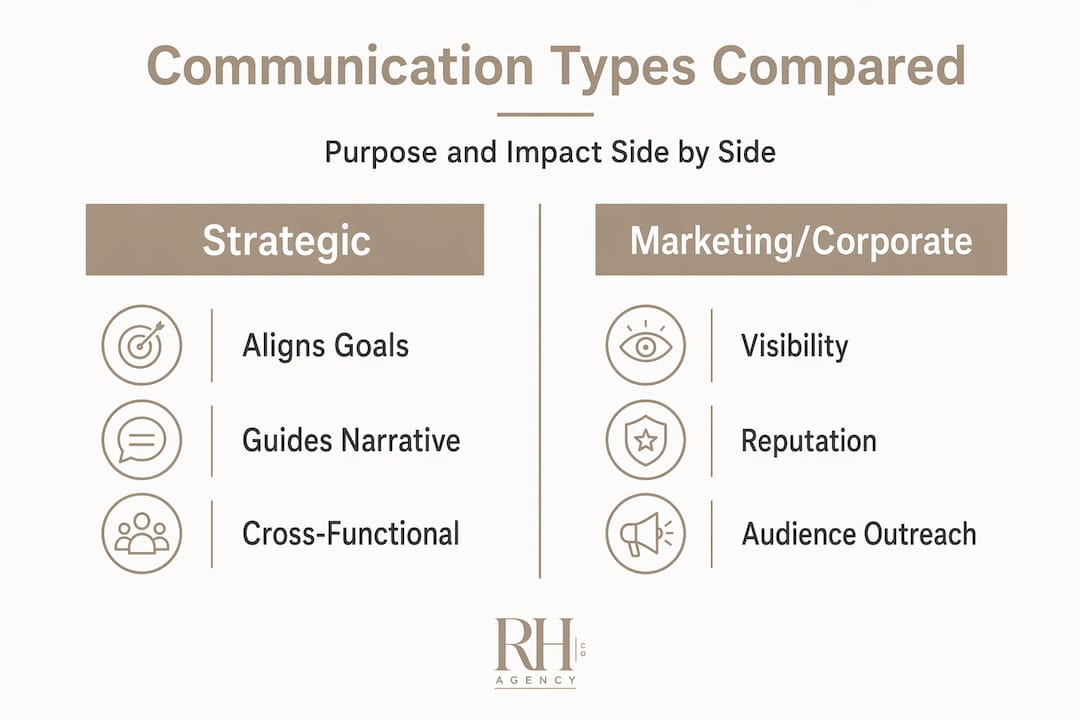
Marketing drives visibility. Corporate communication manages reputation. Strategic communication is the architecture underneath both. It determines what your organization stands for, how that story is told consistently across every channel and spokesperson, and how internal and external messaging reinforce each other rather than contradict.
When organizations assign strategic communication to the marketing team without distinction, the result is messaging that sounds polished but lacks authenticity. When they treat it as a PR function alone, they miss the internal alignment piece entirely. The marketing and communications distinction matters operationally, not just theoretically.
How to implement strategic communication
Knowing the definition is one thing. Knowing how to implement strategic communication inside a real organization is another. Here is a practical sequence that works:
-
Build your message architecture first. Start with the beliefs your leaders genuinely hold and the outcomes the organization is working toward. Message architecture must be defensible and reflect how leaders actually think and behave. Aspirational language that no one in the room actually believes will collapse under the first tough question.
-
Conduct real audience analysis. Map your key audiences, what they currently believe, what they need to understand, and what would change their behavior. This is not a demographic exercise. It is a persuasion exercise.
-
Select channels with intention. Match the message to the medium. A sensitive organizational change warrants a direct leadership conversation, not a company-wide email. A public positioning shift may require a coordinated sequence across media, internal briefings, and stakeholder outreach.
-
Prepare your spokespeople. Anyone delivering your message needs more than talking points. They need to understand the reasoning behind the message and be able to answer hard questions without drifting off-narrative.
-
Set measurement benchmarks before you start. Pre-set benchmarks linked to business outcomes are critical. Moving the goalposts after results come in is one of the fastest ways to lose credibility with leadership and undermine the strategic value of your communication function.
Pro Tip: Avoid the common trap of aspirational messaging. If your message describes where you want to be rather than where you actually are, audiences will sense the gap and trust will erode.
Organizational structures that support strategic communication
Even the best strategy fails without the right operational structure behind it. A few patterns consistently show up in organizations that execute strategic communication well.
- Matrixed team structures. 42% of organizations have shifted to matrixed models, surpassing centralized structures at 38%. This shift reflects a need for agility, where communication professionals work across functions rather than in isolated silos.
- Cross-functional collaboration. Strategic communication works best when communications, operations, and leadership are in the same planning conversations, not just the same distribution lists.
- Continuous listening loops. Feedback from employees, customers, and stakeholders should inform messaging in real time, not just at annual review cycles.
- Balanced channel mix. Digital channels offer speed and reach, but in-person or direct communication carries trust and nuance that no platform fully replicates.
The organizations that treat communication as an operational function, not a publishing function, are the ones that build the most durable alignment.
My take on why most organizations get this wrong
I have seen this pattern repeat itself across growing businesses and executive teams. Strategic communication gets treated as a nice-to-have until a crisis forces the issue. By then, the message architecture does not exist, the spokespeople are unprepared, and the organization is reacting instead of leading.
What I have found is that the most effective leaders treat communication as anticipatory, not reactive. They think through stakeholder reactions before decisions are announced. They build message frameworks that can hold up under pressure because those frameworks reflect real thinking, not polished language written after the fact. And they measure their communication efforts against business outcomes, not just activity metrics.
The uncomfortable truth is that strategic communication is a force multiplier for everything else you are trying to do operationally. When your team understands the why behind decisions, execution improves. When stakeholders trust your narrative, relationships become easier to manage. When your messaging is consistent across every function, your credibility compounds over time. Most organizations are leaving that multiplier on the table.
— Jessica
How The Right Hand Agency Co can help
If you are an executive or business owner who knows your communication needs to be more deliberate but does not have the bandwidth to build that infrastructure alone, The Right Hand Agency Co works alongside leaders to close exactly that gap.

Our executive assistant services keep leadership communications organized, consistent, and on schedule, from preparing briefing documents to coordinating stakeholder outreach. We also provide marketing and social media support that aligns your external messaging with your internal narrative. And through our operations consulting, we help you build the workflows and delegation systems that make strategic communication sustainable, not a one-time effort. You do not need a full-time team to communicate strategically. You need the right support structure.
FAQ
What is the definition of strategic communication?
Strategic communication is the deliberate alignment of messages with organizational goals, target audiences, and desired outcomes. It differs from ordinary communication by its clarity of intent and repeatable framework.
How does strategic communication differ from marketing?
Marketing focuses on commercial visibility and lead generation, while strategic communication builds narrative alignment across all audiences and functions. Confusing the two can dilute both efforts and harm long-term credibility.
Why is strategic communication important for business leaders?
It reduces operational confusion, builds stakeholder trust, and anchors employees to business priorities. Teams with aligned communication KPIs are up to 10 percentage points more likely to influence executive leadership.
What are the core elements of strategic communication?
The four core elements are message architecture, audience analysis, channel strategy, and spokesperson preparation. Together they create a framework that keeps all organizational messaging consistent and goal-directed.
How do you measure strategic communication effectiveness?
Set benchmarks tied to specific business outcomes before any communication program begins. Measuring against pre-set goals, rather than adjusting metrics after results come in, is what separates strategic value from activity reporting.