
TL;DR:
- A strategic planning retreat transforms leadership discussions into concrete decisions, commitments, and a clear execution plan. Success depends on thorough preparation, decision-based agendas, small group SWOT analysis, and strong accountability structures to ensure implementation. Proper planning, facilitator neutrality, and operational support are essential to avoid common pitfalls and maximize retreat effectiveness.
A strategic planning retreat is a structured, facilitated session that converts leadership discussions into specific decisions, committed owners, and a clear roadmap for execution. Done well, it is one of the highest-leverage investments a leadership team can make. Done poorly, it produces a binder full of ideas that no one acts on. This guide walks you through every stage of the process, from defining outcomes before you book a venue to building the accountability structures that make retreat decisions stick. Whether you are running your first offsite or fixing a process that has not delivered results, these retreat planning best practices apply directly.
What does a solid conduct strategic planning retreats guide actually require?
The most common mistake leaders make is treating a strategic retreat like a meeting with better coffee. A retreat requires a fundamentally different preparation model, one built around decisions rather than topics.

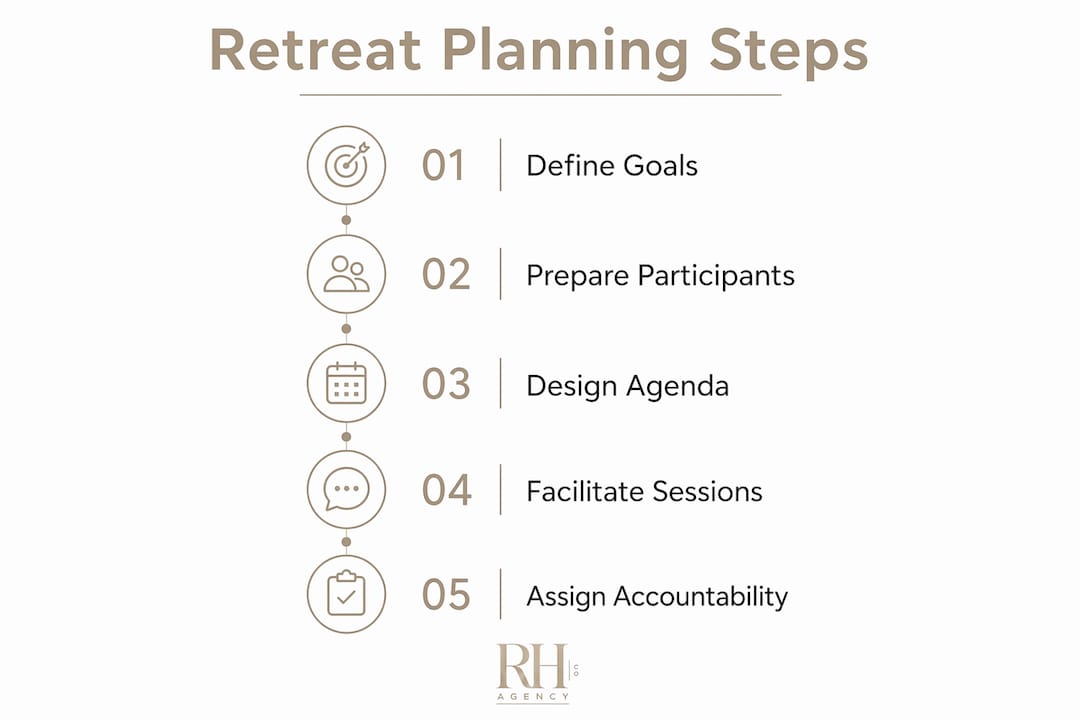
Start by defining the specific decisions and commitments the retreat must produce before you plan a single session. "Discuss our growth strategy" is a topic. "Decide which two markets we will enter in the next 18 months and name the executive responsible for each" is a decision. That distinction shapes everything from your agenda to your participant list.
Distributing a clear outcomes brief at least two weeks in advance ensures participants arrive prepared and focused on those specific decisions. This is not optional. Leaders who walk in cold spend the first two hours catching up instead of contributing.
Use a phased planning timeline to stay organized. A 30/60/90-day checklist phases retreat preparation to prevent last-minute chaos: define goals and budget at 90 days, confirm venue and travel at 60 days, and finalize the agenda at 30 days. The final week should be for confirmation, not creation.
Key preparation checklist:
- Define 3 to 5 specific decisions the retreat must produce
- Identify the right participant group, typically 8 to 15 people with diverse functional perspectives
- Select a venue that removes participants from daily operational distractions
- Assign or hire a facilitator before finalizing the agenda
- Distribute pre-work materials, including data, financial summaries, and the outcomes brief, two weeks out
Pro Tip: Choose a venue at least 30 minutes from your office. Physical distance from the building signals mental distance from daily operations, and that shift matters more than you think.
How do you design an agenda focused on decisions, not topics?
Most retreat agendas are structured around topics because topics are easy to list. Decision-based agendas require more upfront thinking, but they produce measurably better outcomes.
| Agenda type | Structure | Typical output |
|---|---|---|
| Topic-based | "Review competitive landscape, discuss talent gaps, explore new markets" | Notes, observations, open questions |
| Decision-based | "Decide top 3 strategic priorities for FY2026, select market entry sequence, assign ownership" | Named decisions, committed owners, timelines |
The difference is not cosmetic. A topic-based session ends when time runs out. A decision-based session ends when the decision is made and documented.
Effective leadership offsites should also be planned with emotional outcomes in mind, specifically how you want your team to feel during and after the retreat. A team that feels heard and respected commits more deeply to the decisions made. That means building in white space between sessions for informal conversation and reflection. Back-to-back scheduled content creates fatigue and shuts down the kind of lateral thinking that produces real breakthroughs.
A well-paced one-day retreat agenda looks like this: 90 minutes for context-setting and SWOT review in the morning, a 30-minute break, 90 minutes for strategic priority setting before lunch, a 60-minute working lunch with unstructured conversation, 90 minutes for decision-making and ownership assignment in the afternoon, and 45 minutes for commitment documentation and next steps. That structure leaves room for the retreat to breathe without losing momentum.
Pro Tip: Lock your agenda at least 30 days out. Last-minute agenda changes cause fatigue and reduce effectiveness. Participants who receive a revised agenda the night before arrive anxious, not prepared.
What are best practices for SWOT analysis and group work?
SWOT analysis is the most widely used strategic planning tool in retreat settings, and it is also the most frequently misused. The problem is not the framework. The problem is how groups execute it.
Pre-retreat individual SWOT homework is non-negotiable. When every participant completes their own SWOT assessment before arriving, the group discussion starts with factual inputs rather than brainstorming from scratch. You get richer data and faster convergence.
During the retreat, break into small SWOT teams of 4 to 8 participants to ensure engagement and diversity of perspectives. Groups larger than eight tend to default to the loudest voices. Groups smaller than four lack the range of functional perspective needed to stress-test assumptions.
Here is a proven sequence for the SWOT session:
- Distribute individual SWOT summaries to all participants at the start of the session
- Form small groups of 4 to 8 and allocate approximately 3 hours for sharing and generating collective SWOT factors
- Each group presents their top three findings per quadrant to the full room
- Facilitate a pattern-recognition exercise to identify themes across groups
- Vote or rank to surface the top strategic thrusts that will drive the rest of the agenda
Small, diverse SWOT groups reduce social loafing and generate richer strategic insight, transforming individual assessments into collective priorities. That shift from individual to collective is where alignment actually happens.
Pro Tip: Assign a note-taker to each small group, not a participant who is also contributing. Trying to both think and record degrades both activities.
How do you build accountability so retreat decisions actually get executed?
The retreat ends. Everyone flies home. Three months later, half the decisions have stalled and no one is sure who owns what. This is the most predictable failure mode in strategic planning workshops, and it is entirely preventable.
Retreat outputs should be treated as governance-grade artifacts with named owners, deadlines, and success metrics. That means capturing decisions in real time during the retreat, not reconstructing them from notes afterward. Every decision recorded should include: what was decided, who owns it, what the deadline is, and how success will be measured.
Post-retreat accountability structure:
- Create a formal action register during the retreat, not after
- Assign a single named owner to each commitment, not a team or department
- Schedule a 30-day check-in before the retreat ends to review early progress
- Schedule a 90-day review to assess whether strategic priorities are on track
- Separate strategic decisions from tactical execution planning so leaders are not pulled back into operational detail during follow-up sessions
Separating strategy generation from tactical implementation during retreats avoids conflating different types of decisions. The retreat is for strategic choices. Tactical planning happens afterward, in smaller working groups with the relevant owners.
| Accountability element | What it includes |
|---|---|
| Decision record | Decision text, date, named owner, deadline |
| Success metric | Measurable outcome that confirms completion |
| Follow-up schedule | 30-day and 90-day structured review sessions |
| Action register | Living document updated by owners between reviews |
Key takeaways
Successful strategic planning retreats require decision-focused agendas, prepared participants, neutral facilitation, and governance-grade accountability structures to produce lasting results.
| Point | Details |
|---|---|
| Define decisions before planning | Identify 3 to 5 specific decisions the retreat must produce before booking a venue or building an agenda. |
| Distribute pre-work two weeks out | Send the outcomes brief and pre-reading at least two weeks in advance so participants arrive prepared. |
| Use decision-based agendas | Structure every session around a specific decision or commitment, not a topic or discussion theme. |
| Run SWOT in small groups | Groups of 4 to 8 generate richer insight and reduce social loafing compared to full-room exercises. |
| Capture governance-grade outputs | Record every decision with a named owner, deadline, and success metric before the retreat ends. |
Why I think most retreats fail before they start
After working with dozens of leadership teams on operational planning and executive support, the pattern is consistent. The retreat itself is rarely the problem. The problem is everything that happens, or does not happen, in the six weeks before and the six weeks after.
Leaders underestimate how much preparation shapes the quality of conversation in the room. When participants arrive without pre-work, the first half of the retreat becomes a catch-up session. When the CEO facilitates, external facilitators enable unfiltered dialogue in ways that a positional leader simply cannot. The CEO's presence in the facilitator role changes what people say, even when no one intends it to.
The follow-up failure is even more predictable. Retreat outputs get captured in a slide deck, shared once, and never referenced again. The emotional design of leadership offsites impacts the depth of commitment afterward, but commitment without a tracking structure evaporates within weeks.
What actually works is treating the retreat as a project with a defined scope, clear deliverables, and an operational owner responsible for logistics, communication, and follow-up. That is not a job for the CEO. It is a job for a skilled operational partner who can manage the details so leaders can focus on the decisions.
— Jessica
How The Right Hand Agency Co can support your next retreat
Running a high-quality strategic retreat takes more operational coordination than most leadership teams anticipate. Participant communication, pre-work distribution, venue logistics, agenda formatting, and post-retreat follow-up tracking all require focused attention that executives rarely have bandwidth for.

The Right Hand Agency Co provides executive assistant support and operational consulting specifically designed to take that coordination off your plate. From managing the pre-retreat outcomes brief and participant prep to building your post-retreat action register and scheduling follow-up reviews, the team handles the operational layer so your leadership team can focus entirely on strategy. If you want your next retreat to produce decisions that actually get executed, having the right operational support in place is what makes that possible.
FAQ
What is a strategic planning retreat?
A strategic planning retreat is a structured, facilitated offsite session where leadership teams make specific strategic decisions, align on priorities, and assign ownership for execution. It differs from a regular meeting in its preparation requirements, facilitation structure, and accountability outputs.
How far in advance should you plan a strategic retreat?
Start planning at least 90 days out. Use that time to define goals and budget, confirm the venue and facilitator at 60 days, and finalize the agenda at 30 days. The final week should be reserved for confirmation and logistics, not agenda creation.
Should the CEO facilitate the strategic planning retreat?
No. CEO-led facilitation often limits candor and biases group outcomes. A neutral, external facilitator maintains objectivity and enables more honest, balanced participation from all team members.
How do you prevent retreat decisions from stalling after the event?
Capture every decision during the retreat as a governance-grade record with a named owner, deadline, and success metric. Schedule 30-day and 90-day follow-up sessions before the retreat ends to maintain accountability and momentum.
How many people should attend a strategic planning retreat?
Most practitioners recommend 8 to 15 participants for full-group sessions. For SWOT and breakout work, groups of 4 to 8 produce the best balance of diverse perspectives and active engagement.