

Most business leaders believe they have a strategy. Few actually execute one. Around 67% of strategic failures stem from execution breakdowns, not bad ideas. That number should stop you cold. It means the problem is rarely the plan itself. It’s what happens, or doesn’t happen, after the plan is written. Understanding why strategic planning matters goes far beyond knowing you need a direction. It’s about building a discipline that keeps your entire organization moving toward the same goals, making smarter decisions faster, and staying competitive when conditions shift beneath your feet.
Table of Contents
Key takeaways
| Point | Details |
|---|---|
| Planning is an active discipline | Effective strategic planning is iterative and ongoing, not a static document reviewed once a year. |
| Execution gaps kill most strategies | 67% of strategic failures trace back to poor execution, not flawed ideas. |
| Alignment drives measurable results | Strategic alignment accounts for 31% of the performance gap between high and low performers. |
| Capacity is a strategic input | Overambitious plans fail because leaders ignore headcount, skills, and bottlenecks when setting goals. |
| Fewer goals, better outcomes | Prioritizing a small number of well-defined objectives consistently outperforms sprawling initiative lists. |
Why strategic planning matters for organizations
Strategic planning gives your organization something most businesses desperately lack: a shared filter for decisions. When your team knows the three things that matter most this year, they stop wasting time on work that feels productive but moves nothing forward.
The core function of strategic planning is to clarify where you are going, why it matters, and what you will and will not do to get there. That last part is where most leaders struggle. Strategy is as much about saying no as it is about committing to a direction.
Here is what strong strategic planning actually does for your organization:
-
Aligns resources with priorities. Resource alignment accelerates execution and directly impacts profitability by reducing wasted time, budget, and effort on low-priority work.
-
Creates a decision-making filter. When a new opportunity or crisis appears, your strategy tells you whether to act or ignore it. Without that filter, every shiny object becomes a distraction.
-
Builds employee engagement. Connecting individual roles to the broader mission increases commitment, satisfaction, and retention across your team.
-
Enables proactive risk management. Leaders who plan strategically spot threats earlier and respond with intention rather than panic.
-
Drives cultural cohesion. Shared goals create shared identity. Teams that understand the mission perform better and collaborate more naturally.
Pro Tip: Before your next planning session, ask every department head to name the top three organizational priorities. If the answers differ, you have an alignment problem that no amount of planning documents will fix on their own.
The importance of strategic planning becomes most visible under pressure. When markets shift or a competitor moves aggressively, organizations with clear strategic priorities adapt faster because they already know what matters and what to protect.

The data behind strategic planning’s impact
Numbers tell a story that opinions cannot. The evidence for why strategic planning matters is not theoretical. It shows up in revenue, shareholder value, and employee performance.
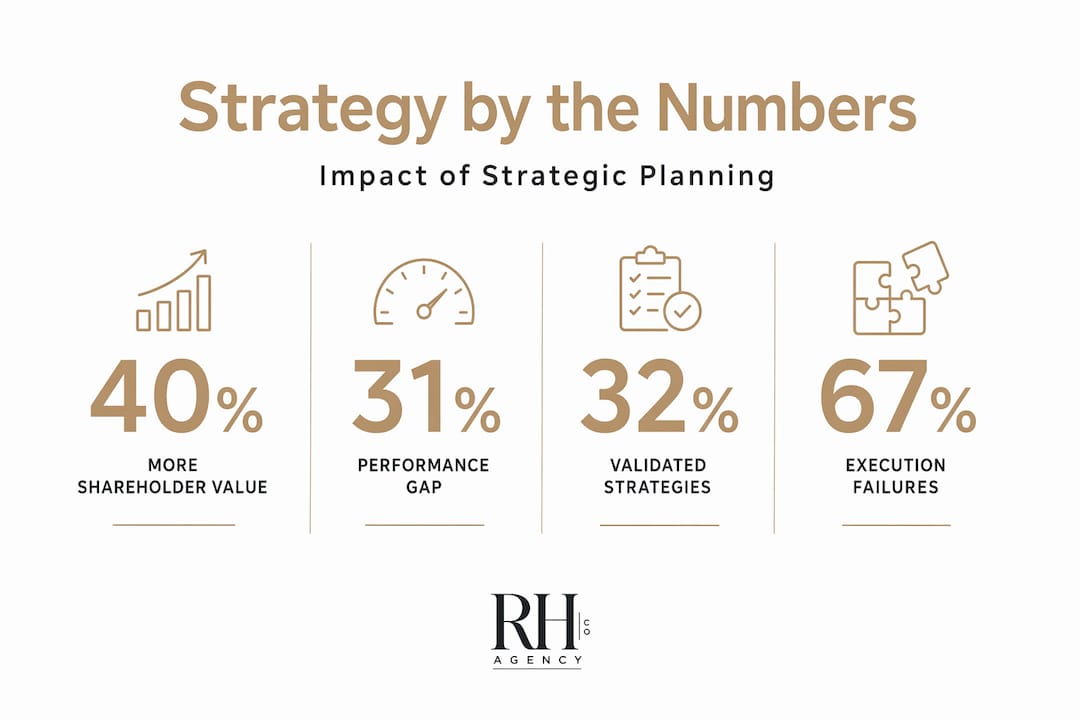
| Metric | Finding | Source |
|---|---|---|
| Long-term shareholder value | 40% more value delivered by organizations with disciplined planning | TransparentChoice |
| Strategic target achievement | Only 1 in 5 organizations surpasses 80% of their strategic targets | TransparentChoice |
| Long-term strategy adoption | 55% of companies lack a five-year strategy with regular review | Harian Basis |
| Execution failure rate | 67% of strategic failures trace to execution gaps, not bad ideas | TransparentChoice |
| Performance differential | 31% of the gap between high and low performers ties directly to alignment | TransparentChoice |
The alignment statistic deserves special attention. A 31% performance differential from alignment alone means that two organizations with identical products, markets, and budgets can produce dramatically different results based purely on how well their teams are pointed in the same direction.
What makes these numbers even more striking is the external validation gap. Only 32% of companies test their strategy against external market realities to confirm it is realistic and resilient. Most leaders build plans in internal echo chambers, then wonder why the market responds differently than expected.
The strategic planning significance here is clear. Planning without validation is wishful thinking dressed up in a slide deck. The organizations that consistently win treat their strategy as a hypothesis to be tested, not a conclusion to be defended.
Why strategic plans fail
The benefits of strategic planning are well documented. So why do so many plans collapse in execution? The answer almost always comes down to a handful of predictable mistakes that leaders repeat across industries and company sizes.
-
Treating strategy as a static document. Effective planning must be an active discipline, not an 18-month cycle that produces a binder no one reads after the kickoff meeting. Markets move. Your strategy needs to move with them.
-
Ignoring capacity as a strategic input. Most plans are built around goals without asking whether the organization has the skills, headcount, and bandwidth to execute them. Overambitious plans do not fail because the goals were wrong. They fail because no one counted the hours required to achieve them.
-
Blurring accountability. When everyone owns a goal, no one owns it. Plans without clear decision rights and named owners create a diffusion of responsibility that kills momentum within the first quarter.
-
Siloing strategy from operations. Execution gaps arise when strategy and operations remain disconnected, with high-level goals floating above daily activities rather than driving them. If your team cannot connect their Monday morning tasks to the annual plan, the plan is not working.
-
Failing to adapt. Stress-testing and iterating on strategic plans improves resilience and allows teams to cut initiatives that no longer serve the evolving goals. Organizations that treat their strategy as sacred rather than revisable tend to execute the wrong plan with great discipline.
Pro Tip: Run a quarterly “strategy health check” where you review three things: what is working, what has changed in your market, and which initiatives should be stopped. Stopping something is a strategic decision, not a failure.
Making strategic planning a living process
The organizations that get the most out of strategic planning treat it as an operating system, not an annual event. Here is what that looks like in practice.
Use strategy as a filter, not a wish list
Every new initiative, budget request, or hire should pass through a simple question: does this move us toward our defined priorities? If the answer is no, it waits or gets cut. This sounds obvious, but most leadership teams approve work reactively and then wonder why the strategy never gets executed.
Define fewer goals with sharper outcomes
Well-built strategic plans include clear goals with cascaded priorities, decision rights, scorecards or OKRs, budget-to-strategy linkage, and regular monitoring meetings. The common failure is trying to pursue twelve strategic priorities simultaneously. Three to five well-defined goals with clear owners and measurable outcomes will outperform a sprawling list every time.
Build capacity into the plan from day one
Capacity planning means accounting for skills, headcount, and bottlenecks before you commit to timelines. A goal that requires 40 hours per week from a team already running at 90% capacity is not a strategy. It is a setup for burnout and missed targets.
Here is a quick comparison of reactive versus disciplined planning approaches:
| Approach | Reactive planning | Disciplined strategic planning |
|---|---|---|
| Decision-making | Based on urgency and instinct | Filtered through defined priorities |
| Resource allocation | Spread thin across many initiatives | Concentrated on highest-impact goals |
| Accountability | Diffuse and informal | Named owners with clear metrics |
| Adaptation | Triggered by crisis | Built into regular review cycles |
| Employee clarity | Low, frequent confusion | High, connected to daily work |
Connect strategy to daily activity
Strategic planning is shifting toward continuous, outcome-focused practices that link high-level objectives to real-time decision-making. The practical version of this is making sure every team member can answer: “What does winning look like for me this week, and how does it connect to what the organization is trying to accomplish this year?”
How strategic planning drives real business results
When strategic planning is done well, the benefits show up in ways that matter to you as a leader.
-
Faster decisions under uncertainty. When priorities are clear, your team does not need to escalate every judgment call. They already know what matters most.
-
Better resource utilization. Companies that realign capital and talent with goals deliver 40% more total shareholder return compared to peers who do not.
-
Stronger employee retention. Teams that understand how their work connects to the mission stay longer and perform better. That is not soft data. It is a direct cost reduction in recruiting and onboarding.
-
Clear accountability that accelerates execution. When every initiative has a named owner and a defined outcome, work moves faster and excuses disappear.
-
Competitive differentiation. A well-executed strategy is one of the few things competitors cannot easily copy. Your culture, your priorities, and your discipline in executing them are yours alone.
-
Agility to seize opportunities. Strategic planning strongly influences trust and engagement across customers, partners, and investors when progress is transparent and consistent.
The role of strategic planning is not to predict the future. It is to build an organization capable of responding to the future with clarity and speed.
My honest take on why most strategies fail
I have worked with enough business owners and leadership teams to say this plainly: most strategic plans fail because of culture and leadership behavior, not because of the tools or frameworks used.
Leaders often approach planning as a performance. They schedule the offsite, fill the whiteboard, and produce a polished document. Then they go back to their offices and make decisions the same way they always have. The plan becomes a reference document that no one references.
What I have found actually works is courageous simplification. The leaders who execute well are not the ones with the most detailed plans. They are the ones willing to say, “We are not doing that this year,” and mean it. They protect their team’s capacity. They make the strategy visible in weekly conversations, not just quarterly reviews.
The other thing I keep seeing is the gap between strategy and capacity awareness. Leaders set ambitious goals without ever asking whether the organization has the bandwidth to pursue them. Then they blame execution when the real problem was that the plan was never realistic to begin with.
Technology and AI can help you track progress and surface data faster. But they do not replace the leadership discipline required to make hard trade-offs, hold people accountable, and stay focused when everything feels urgent. That part is still entirely human.
— Jessica
How Therhagency helps leaders execute their strategy
Building a strategy is one thing. Executing it without a full-time team is another challenge entirely. That is exactly the gap Therhagency was built to close.

The Right Hand Agency works with business owners and financial advisory firms who need real operational support without the overhead of full-time hires. From executive support services that keep your priorities moving forward, to business operations consulting that aligns your resources with your goals, to technology and systems support that gives you real-time visibility into your progress, every service is built around helping you close the gap between strategy and results. You do not need a bigger team. You need the right support at the right level.
FAQ
What is the main reason strategic plans fail?
67% of strategic failures trace back to execution breakdowns rather than flawed ideas. The most common culprits are unclear accountability, disconnected operations, and overambitious goals that ignore available capacity.
How often should a strategic plan be reviewed?
Strategic planning is most effective as a continuous, iterative practice rather than an annual event. Most high-performing organizations conduct formal reviews quarterly and adjust priorities based on market changes and internal performance data.
What is the role of strategic planning in small businesses?
Strategic planning helps small businesses and entrepreneurs prioritize limited resources, make faster decisions, and avoid reactive work that consumes time without advancing growth. It is especially critical when you are operating with a lean team and cannot afford to pursue the wrong priorities.
How does strategic alignment affect business performance?
Strategic alignment accounts for 31% of the performance difference between high and low-performing organizations across revenue growth, profitability, and customer satisfaction. Alignment is one of the highest-leverage investments a leadership team can make.
Can strategic planning help with employee retention?
Yes. Connecting individual roles to the broader organizational mission increases employee commitment and satisfaction. Teams that understand how their daily work contributes to meaningful goals stay longer and perform at a higher level.