
TL;DR:
- Effective management of business consultants involves clear role definition, structured onboarding, and outcome-based performance tracking to ensure project success. Utilizing centralized platforms and SMART goals prevents scope creep, enhances visibility, and maximizes ROI for small businesses. Regular outcome-focused communication and rewarding scope critique enable consultants to deliver meaningful impact aligned with strategic goals.
Effective consultant management is defined by three non-negotiable elements: clear role definition, outcome-focused communication, and centralized oversight. When business owners treat consultants as strategic partners rather than hired hands, project outcomes improve and budget overruns drop. The challenge is that most executives know how to hire consultants but not how to manage business consultants effectively once they are engaged. This article gives you the operational framework to change that, covering everything from SMART-based goal setting and structured onboarding to technology platforms and performance tracking.
How to manage business consultants effectively from day one
The single biggest mistake executives make is hiring a consultant based on an impressive resume rather than a specific problem they need solved. Vetting by problem-solving ability rather than credentials leads to better value and measurable results. A consultant hired to "improve operations broadly" will drift. A consultant hired to "reduce client onboarding time from 14 days to 5 days" has a target they can hit.

Use SMART criteria to define every consultant engagement before the contract is signed. That means goals must be Specific, Measurable, Achievable, Relevant, and Time-bound. SMART criteria and formal onboarding starting before Day 1 are directly linked to higher project success rates. Vague deliverables create scope creep, billing disputes, and frustration on both sides.
Here is what a well-structured consultant brief must include:
- A precise problem statement tied to a business outcome
- Defined deliverables with deadlines and quality benchmarks
- Reporting cadence and escalation protocols
- Budget ceiling and change-order approval process
- Named internal stakeholders the consultant will work with
Pro Tip: Before signing any consultant agreement, write one sentence that completes this prompt: "This engagement succeeds when ___." If you cannot complete it clearly, the scope is not ready.
Consultants with narrowly defined expertise aligned to your specific business problem are easier to manage, easier to evaluate, and more likely to deliver. Broad generalists create accountability gaps. Specialists create clarity.
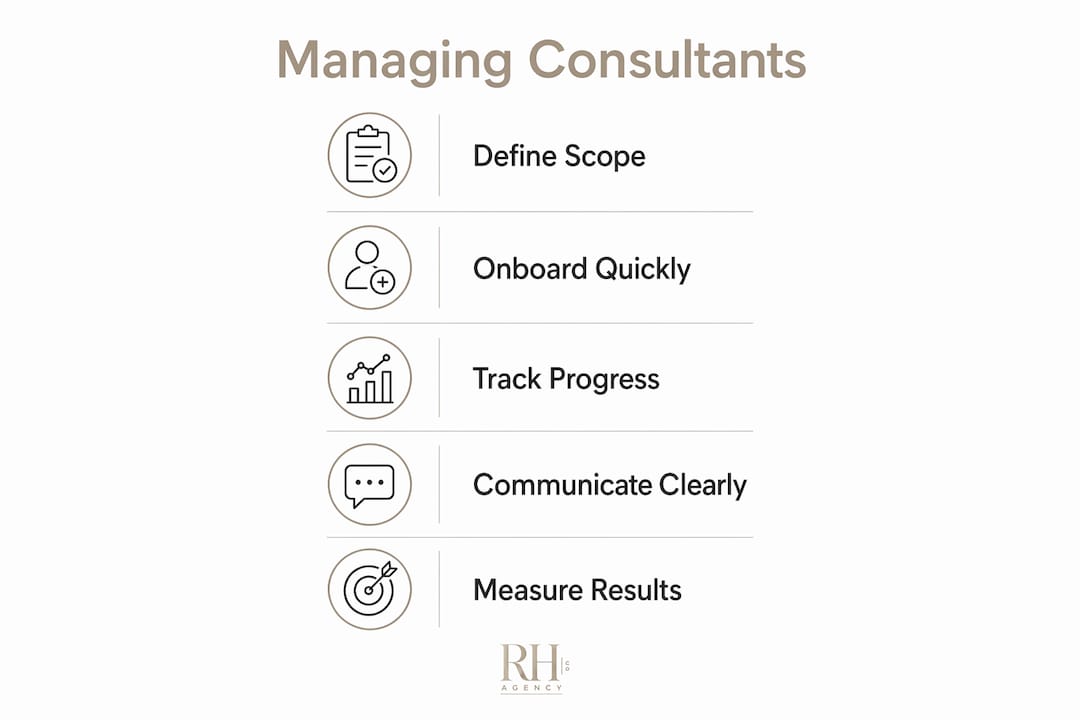
What does a strong consultant onboarding process look like?
Onboarding is the highest-leverage phase of any consultant engagement. Most executives rush it or skip it entirely, then wonder why the project stalls in week three. Meaningful onboarding that provides system access, stakeholder connections, and clear documented plans by Day 1 directly improves consultant performance.
Follow this sequence to set every engagement up correctly:
- Grant system access before Day 1. Provide login credentials, project management tools, shared drives, and any CRM or reporting platforms the consultant needs. Waiting until week two costs billable hours and signals disorganization.
- Schedule a kickoff meeting within the first 48 hours. Cover project purpose, success criteria, key contacts, and communication norms. This is not a formality. It is the moment expectations become shared.
- Introduce key internal stakeholders immediately. The consultant should know who owns decisions, who holds subject-matter knowledge, and who approves deliverables. Ambiguity here causes delays.
- Centralize all documentation in one location. Contracts, project plans, timelines, and reference materials belong in a single shared workspace, not scattered across email threads.
Pro Tip: Create a one-page "Consultant Quick Start" document for every engagement. Include key contacts, tool logins, communication preferences, and the single most important project goal. It takes 30 minutes to build and saves hours of back-and-forth.
If you work with part-time or fractional consultants, structured onboarding matters even more because their time on your project is limited and every hour counts.
Which technology platforms help you maintain visibility and control?
Centralized management software is the difference between controlled consultant engagements and projects that quietly drift off track. All-in-one consulting platforms can reduce administrative time so dramatically that a 10-person firm can complete monthly billing in about 2 hours instead of 2 days. That time savings compounds across every engagement you run simultaneously.
The table below shows what you should be tracking and why each metric matters:
| Metric | What it tells you |
|---|---|
| Deliverable completion rate | Whether the consultant is hitting agreed milestones on schedule |
| Budget utilization vs. plan | Early warning signal for scope creep or underestimated complexity |
| Consultant utilization rate | Whether you are getting full value from contracted hours |
| Timeline variance | How accurately the engagement was scoped at the start |
| Change order frequency | Indicator of unclear initial scope or shifting business priorities |
Treating consultant engagements as centralized records that consolidate contracts, deliverables, billing, and capacity plans prevents the project drift that kills ROI. Platforms priced at $19 to $39 per seat per month make this accessible for small businesses, not just enterprise teams.
Pro Tip: Assign one internal owner to each consultant engagement. That person owns the shared workspace, tracks milestone completion, and flags issues before they escalate. Without a named owner, accountability dissolves.
The technology systems you use to manage consultants should connect to your broader operational infrastructure, including your CRM, project management platform, and billing tools.
What are the best communication practices with consultants?
The most common management failure with consultants is not under-communicating. It is communicating in the wrong way at the wrong frequency. Micromanagement destroys consultant motivation and wastes your time. Under-communication creates misalignment that surfaces too late to fix cheaply.
The right model is outcome-based management with structured touchpoints. Here is what that looks like in practice:
- Weekly async updates via a shared project log, not a meeting. The consultant posts progress, blockers, and next steps. You review and respond within 24 hours.
- Bi-weekly live check-ins of 30 minutes or less. Focus on decisions that require your input, not status reporting.
- Milestone reviews tied to deliverables, not the calendar. When a deliverable is complete, review it within 48 hours and provide written feedback.
- A documented escalation path so the consultant knows exactly who to contact when a blocker requires executive decision-making.
Collaboration between consulting and internal teams improves when communication norms are agreed upon at the start of the engagement, not improvised along the way. Standardized templates for status updates and review checkpoints reduce the cognitive load on both sides and create a paper trail that protects everyone.
How do you measure consultant performance and optimize engagements?
Consultant KPIs must connect directly to business outcomes, not activity metrics. Tracking hours logged or meetings attended tells you nothing about value delivered. The right question is: did this engagement move the business forward in a measurable way?
| Weak KPI | Strong KPI |
|---|---|
| Hours billed per week | Revenue impact per engagement dollar |
| Number of reports submitted | Decision quality improvement rate |
| Meetings attended | Milestone completion rate vs. plan |
| Tasks completed | Reduction in target problem metric |
Data-driven performance evaluation allows you to identify which consultants deliver consistent ROI and which engagements were scoped incorrectly from the start. Both insights are valuable. The first tells you who to rehire. The second tells you how to write better briefs.
The most valuable consultants proactively identify gaps in the initial project framing and help refine scope for greater impact. This means your performance review process should reward consultants who push back constructively, not just those who execute quietly. Encourage scope critique early. It is far cheaper to adjust a project plan in week one than to discover a fundamental misalignment in week eight.
Document every scope change through a formal change-order approval process. This single practice prevents the majority of billing disputes and protects both parties.
Key takeaways
Effective consultant management requires precise role definition, structured onboarding, centralized tracking, and outcome-based performance measurement from the first day of every engagement.
| Point | Details |
|---|---|
| Define scope with SMART criteria | Vague deliverables create scope creep; specific goals create accountability. |
| Onboard before Day 1 | System access and stakeholder introductions before the first day accelerate productivity. |
| Centralize all engagement records | Contracts, deliverables, and billing in one platform prevent project drift and budget overruns. |
| Manage outcomes, not activity | KPIs tied to business results reveal true consultant value better than hours tracked. |
| Reward constructive scope critique | Consultants who refine project framing early deliver more impact than those who only execute. |
What I have learned about structure and flexibility in consultant management
From working with business owners and executives across a range of industries, the pattern I see most often is this: leaders either over-structure or under-structure consultant engagements, and both extremes cost money.
Over-structuring looks like weekly status meetings, daily check-ins, and approval requirements for minor decisions. It signals distrust and drives good consultants away. Under-structuring looks like a signed contract followed by silence until a deliverable is due. It creates misalignment that surfaces at the worst possible moment.
The consultants who deliver the most value are the ones you treat as thinking partners, not task executors. That means sharing context about your business goals, inviting them to challenge your assumptions, and giving them enough autonomy to do their best work. The benefits of executive consulting support multiply when the relationship is built on mutual respect and clear expectations, not just a statement of work.
Technology enables this balance. A centralized platform handles the administrative oversight so you do not have to. That frees you to focus on the strategic conversation, which is where the real value of a consultant relationship lives.
— Jessica
How The Right Hand Agency Co can support your consultant operations
Managing multiple consultants while running a business is a real operational load. The Right Hand Agency Co works with small business owners and executives to build the systems, processes, and support structures that make consultant engagements run smoothly from kickoff to final deliverable.
From executive assistant support that handles consultant coordination and communication to technology and systems integration that centralizes your project tracking, The Right Hand Agency Co provides the operational backbone you need. You focus on the strategic work. We handle the infrastructure that keeps it moving. If you are ready to get more from your consultant relationships without adding overhead, reach out to The Right Hand Agency Co for a consultation.
FAQ
What does it mean to manage business consultants effectively?
Effective consultant management means defining clear roles using SMART criteria, providing structured onboarding, maintaining centralized oversight of deliverables and budgets, and evaluating performance against business outcomes rather than activity metrics.
How do I prevent scope creep with business consultants?
Document every deliverable and deadline in the original contract, and require formal written approval for any scope changes. This single practice eliminates most billing disputes and keeps projects on track.
What technology should I use to manage consultants?
All-in-one consulting management platforms that centralize contracts, deliverables, billing, and timelines are the most practical solution. Platforms in the $19 to $39 per seat per month range make this accessible for small businesses.
How often should I check in with a business consultant?
A bi-weekly 30-minute live check-in combined with weekly async status updates is the right balance for most engagements. More frequent meetings signal micromanagement and reduce consultant productivity.
How do I know if a consultant is delivering real value?
Link every consultant KPI directly to a business outcome, such as reduced process time, revenue impact, or milestone completion rate. If the metric does not connect to a business result, it is not measuring value.