

TL;DR:
- A business growth strategy is a deliberate, written plan that aligns operational, financial, and leadership capacities with expansion ambitions. Many plans fail due to poor execution and lack of operational infrastructure, not strategy flaws. Regular review, delegation, and systematization are essential for sustainable growth and successful implementation.
Most small business owners think growing their business means selling more. More leads, more clients, more revenue. But a business growth strategy is something fundamentally different. It's a deliberate, written plan that connects your growth ambitions to your operations, finances, and leadership capacity. Get that connection wrong, and growth becomes the thing that breaks your business instead of building it. This guide breaks down exactly what that plan looks like, what types of strategies exist, and how to build one that actually holds up when execution gets hard.
Table of Contents
- Key takeaways
- What is a business growth strategy?
- Types of business growth strategies
- How to build an effective business growth plan
- Operational efficiency and delegation as growth levers
- My take on growth strategy and why so many plans fail
- Grow smarter with The Right Hand Agency Co
- FAQ
Key takeaways
| Point | Details |
|---|---|
| Growth strategy is a plan, not a goal | It maps how your business will grow, not just how much, linking market moves to operational readiness. |
| Strategy type determines risk level | Market penetration is low risk; diversification is high risk. Choose based on your current resources and capacity. |
| Most plans fail in execution | Only one in three businesses that set annual growth goals achieve them, usually due to poor operational alignment. |
| Delegation is a growth lever | Reducing owner overwhelm through executive support directly unlocks the leadership bandwidth needed to scale. |
| Plans need regular revision | Static annual targets disconnect from quarterly realities. Build in review cycles from the start. |
What is a business growth strategy?
A business growth strategy is a deliberate, written plan that details how your business will expand, why that expansion makes sense, and what operational, financial, and leadership conditions need to be in place to pull it off sustainably. It is not a sales target or a marketing calendar. Those are tools inside a strategy, not the strategy itself.
Here is the distinction that matters most: a marketing plan asks, "How do we get more customers?" A growth strategy asks, "What kind of business do we want to be in three years, and are we operationally ready to get there?" That difference in framing changes every decision that follows.
Strong growth strategies typically address several outcomes at once:
- Revenue expansion through new clients, geographies, or channels
- Margin improvement by fixing operational inefficiencies or repricing
- Market entry into a new segment or niche
- Customer mix adjustment to reduce concentration risk
- Leadership readiness and succession as the business scales
Pro Tip: Write your growth strategy as a document, not a slide deck. A document forces specificity. You cannot gloss over the operational or financial gaps when you have to put them in writing.
Effective growth plans typically cover a 12 to 36 month horizon. They are detailed enough to guide execution, not just inspire it. And critically, they must link your growth ambitions to your actual operational capacity. Growth without that link risks overextension, burnout, and value loss for the business you have spent years building.

Types of business growth strategies
Understanding the major categories of growth strategy helps you identify which approach fits your business right now, not just in theory.
| Strategy type | Core idea | Risk level | Best for |
|---|---|---|---|
| Market penetration | Sell more of what you have to existing markets | Low | Established businesses with room to grow market share |
| Product development | Add new offerings for your current customer base | Medium | Businesses with strong client relationships and capacity to build |
| Market expansion | Take existing products into new markets or regions | Medium-High | Proven offerings ready for replication elsewhere |
| Diversification | New products, new markets simultaneously | High | Businesses with capital, systems, and leadership depth |
| Niche focus | Serve a very specific segment exceptionally well | Low-Medium | Smaller businesses competing against larger generalists |
| Recurring revenue | Shift from project to subscription or retainer models | Medium | Service businesses seeking predictable, compounding revenue |
The lower-risk strategies at the top of the table work well for businesses that are still building their operational foundation. Market penetration is often the most underutilized. If you are not maximizing revenue from your current customers, entering a new market will just dilute your focus.
Modern growth strategies in 2026 increasingly emphasize recurring revenue models and niche-focused digital services. Businesses that solve concrete, specific problems for a defined audience outperform generalists in scalability. If you have not yet identified your niche, that is often the most important strategic move before anything else.
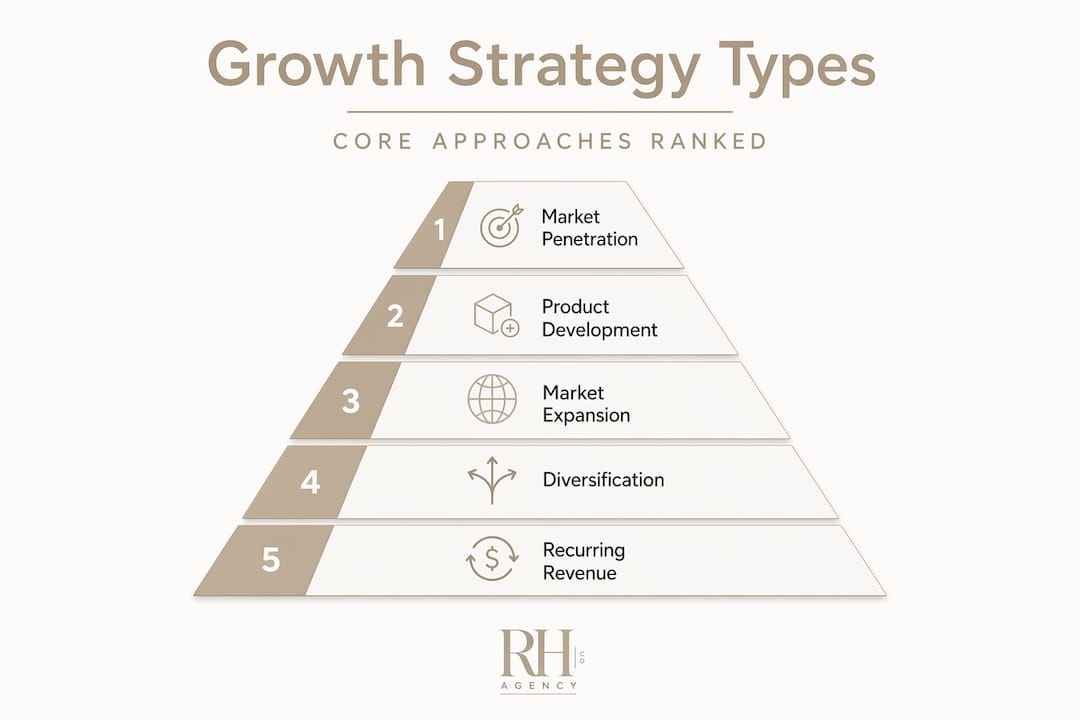
The recurring revenue shift deserves particular attention for service businesses. Moving from project-based work to retainer or subscription arrangements does not just improve cash flow prediction. It changes how you staff, how you price, and how you plan. That is a strategic transformation, not a billing change.
How to build an effective business growth plan
Building a growth plan that actually works requires more than writing down goals. Here is a practical sequence that ties strategy to execution.
-
Set goals with measurable outcomes. Define what growth looks like with specific numbers and timeframes. Use OKRs (Objectives and Key Results) for directional goals and KPIs for operational performance. "Grow revenue by 30% in 12 months by adding 10 enterprise clients" is a goal. "Grow revenue" is a wish.
-
Assess your current position honestly. Look at your market, your operational capacity, and your financial health. Where are the actual bottlenecks? What would break first if revenue doubled tomorrow? This is where most plans skip ahead too fast.
-
Build your financial framework. Financial growth strategy transforms ambition into a plan by aligning your capital structure, revenue targets, and risk profile with long-term goals. Build a dynamic cash forecast and run scenario plans. Growth that strains your cash position is not growth worth pursuing.
-
Create an execution roadmap. Break your goals into quarterly milestones with clear ownership. Each initiative needs a responsible person, a completion date, and defined resources. Ambiguity at this stage is where plans dissolve.
-
Define your review cadence. Most growth plan failures come from process issues, not strategy flaws. Static annual targets lose contact with quarterly realities. Build a monthly or quarterly review into the plan itself, not as an afterthought.
Pro Tip: Use a simple one-page growth plan summary as a communication tool for your leadership team. Long documents do not get read. A one-pager forces prioritization and keeps everyone oriented toward the same outcomes.
Embedding financial strategy into daily operations with real-time dashboards and cash flow tracking converts your plan from a document into a living operating system for your business.
Operational efficiency and delegation as growth levers
Here is the part most growth content ignores: you cannot scale what you cannot systematize. Scaling requires moving from reactive, founder-led efforts to proactive, system-dependent frameworks. That shift is operational, not strategic.
Founders frequently overextend by applying the same hands-on approach that worked at $500K to a business trying to reach $2M. The gap is not strategy. It is operational infrastructure and delegation.
The most practical levers for small businesses are:
- Workflow documentation so that processes do not live in one person's head
- Technology systems that reduce manual effort and create visibility across the business
- Delegation to skilled support roles so that leadership bandwidth focuses on high-impact decisions
- Executive assistant support that removes administrative drag from the owner's day
"Operational inefficiencies and unclear delegation are among the leading causes of growth stalls. Leveraging executive support directly unlocks the leadership bandwidth critical to scaling a business." Seeking Succession
Consider a professional services firm with 12 employees trying to double its client base. The owner spends 15 hours a week on scheduling, inbox management, and project coordination. That is nearly half a standard work week pulled away from business development, client relationships, and strategic thinking. Adding an executive assistant to own those operational tasks is not overhead. It is a growth investment with direct impact on capacity.
For businesses evaluating how to grow without adding permanent headcount, strategic planning alignment with the right operational support structure is often the missing piece.
My take on growth strategy and why so many plans fail
I have worked with dozens of small business owners who had solid growth strategies on paper and still stalled. The honest pattern I have seen: the strategy was real, but the execution infrastructure was not.
What I have learned is that most growth failures are not caused by bad ideas. They are caused by founders who never built the systems and team around them to execute. The business grows in their head faster than it grows in reality because nothing is documented, delegated, or tracked.
The other thing I would push back on is the idea that a growth plan is something you set once a year. In my experience, the businesses that actually hit their targets are the ones that treat their growth plan like a living document. They review it monthly, adjust for what changed, and stay honest about what is not working.
Growth is not accidental. But it is also not a document you write once and file away. It requires consistent operational attention and, increasingly, the support of people who can hold the business together while you focus on moving it forward.
— Jessica
Grow smarter with The Right Hand Agency Co
Understanding growth strategy is the first step. Executing it without burning yourself out is the real challenge.

The Right Hand Agency Co. works directly with small business owners and executives to build and maintain the operational infrastructure that makes growth sustainable. From executive assistant services that free up your leadership bandwidth to operational consulting and technology systems that create visibility across your business, the team functions as your operational partner without the cost of full-time hires. If your growth plan is solid but execution keeps slipping, that is exactly the problem The Right Hand Agency Co. is built to solve. Learn more at therhagency.co.
FAQ
What is a business growth strategy in simple terms?
A business growth strategy is a written plan that defines how your business will expand, covering goals, timelines, resources, and operational requirements. It connects your market ambitions to your internal capacity to execute them sustainably.
How is a growth strategy different from a business plan?
A business plan is typically created at startup to define the business model and financial projections. A growth strategy is an ongoing, evolving document focused specifically on how an established business will scale, adapt, and increase its value over time.
What are the most common types of growth strategies?
The main categories are market penetration, product development, market expansion, diversification, niche focus, and recurring revenue models. Lower-risk options like market penetration work well for businesses still building their operational foundation.
Why do so many business growth plans fail?
Most growth plan failures stem from process and execution gaps, not flawed strategy. Plans that lack clear ownership, measurable milestones, and regular review cycles lose alignment with operational reality quickly.
How does delegation support business growth?
Delegation removes the founder from low-leverage tasks and redirects leadership focus toward high-impact decisions. When owners are buried in administration, growth stalls because the person responsible for strategic direction has no time or energy to execute it.