
TL;DR:
- Advisor business development involves proactively building client relationships, identifying opportunities, and creating systems to ensure steady revenue growth. It requires clear structure, documented plans, and firm-wide collaboration across marketing, sales, and client experience. Successful growth depends on operational support, consistent routines, and strategic partnerships like Centers of Influence.
Advisor business development is defined as the proactive process of identifying new business opportunities, cultivating client relationships, and building repeatable systems that generate consistent revenue growth. For financial advisors and small business owners, this is not a passive activity. It combines marketing, sales, and client experience into one connected growth engine. According to the ISS Market Intelligence Report 2025, 26% of financial advisors name business development as their top practice management challenge. That number tells you how many firms are still treating growth as an afterthought rather than a system.
What is advisor business development, really?
Advisor business development is the structured set of activities an advisor uses to expand their client base, deepen existing relationships, and grow revenue on a predictable schedule. The industry term most commonly used is business development, but in the advisory context it carries a specific meaning: it is not just sales. It covers every stage from first contact to long-term client retention.

The concept matters because growth does not happen by accident. Firms with documented growth plans achieve twice the annualized revenue growth compared to those without one, targeting 15–25% yearly increases in AUM and revenue per client. That gap between planned and unplanned growth is where most advisory practices lose ground.
Three named frameworks define the space. Full Advisor Coaching's Business Development Ecosystem treats growth as a firm-wide responsibility. Select Advisors Institute focuses on compliant growth programs designed specifically for RIAs. Simon Wakeman's advisor model emphasizes pattern recognition across businesses to improve decision quality. Each approach confirms the same principle: advisor business development requires structure, not just effort.
What does an advisor's role in business development include?
The advisor's role in business growth covers a wider range of tasks than most people expect. At the core, advisors are responsible for identifying new opportunities, pitching prospective clients, and maintaining the relationships that drive referrals.
Typical activities include:
- Prospecting and outreach: Scheduling calls, attending events, and following up with warm leads
- Referral program management: Building formal relationships with Centers of Influence such as CPAs and attorneys
- Client relationship deepening: Proactive check-ins, life event conversations, and annual reviews
- Pipeline tracking: Logging activity in a CRM and reviewing conversion rates by channel
- Content and visibility: Contributing to SEO-driven content or appearing in media that reaches ideal clients
Not every advisor should carry formal sales accountability. Forcing all advisors into a sales role without matching it to their personality or training frequently backfires and costs the firm productivity. Some advisors excel at deepening existing relationships. Others are natural prospectors. Knowing the difference is a management decision, not a default assumption.
Pro Tip: Schedule at least 2 hours weekly for dedicated business development activities. Consistent, time-blocked prospecting outperforms sporadic intensive sprints every time.
Hybrid digital marketing also belongs in this role. Firms using a combined SEO and PPC model achieve client acquisition costs 30–50% lower over 18 months than those relying on traditional methods alone. That cost reduction directly improves the return on every hour an advisor spends on outreach.
How does BD strategy integrate marketing, sales, and client experience?
The Business Development Ecosystem, developed by Kristin Harad at Full Advisor Coaching, defines business development as a firm-wide ecosystem where marketing, sales, and client experience are all connected. Every touchpoint, from your website to your onboarding process to your annual review format, either contributes to growth or works against it.
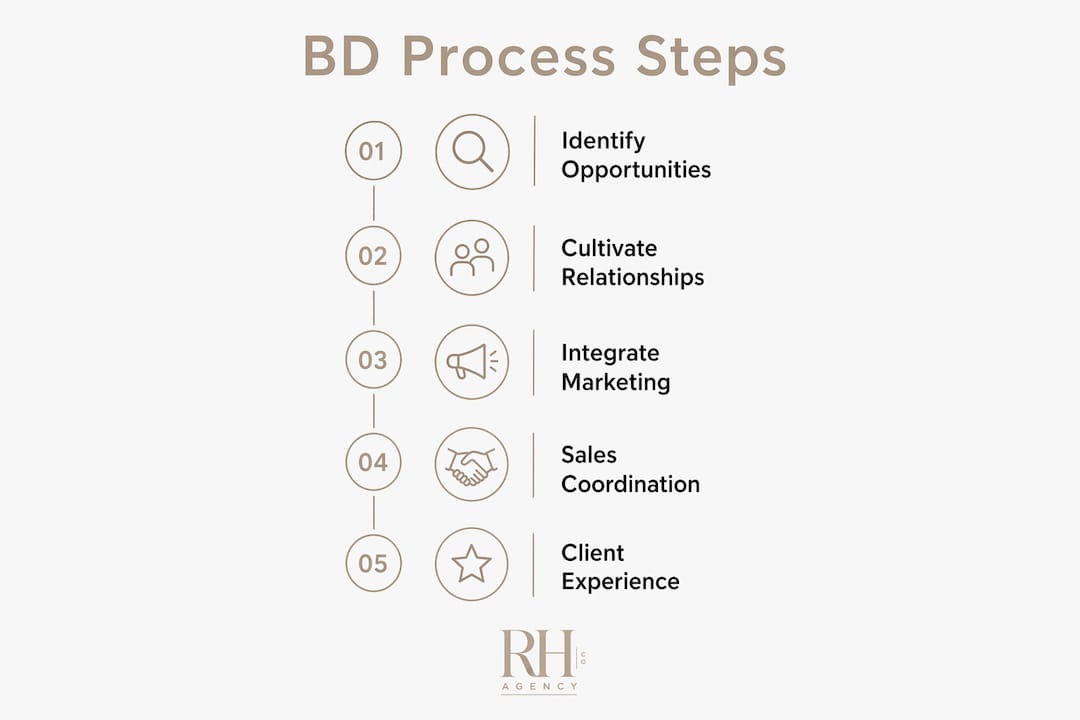
The contrast between siloed and integrated approaches is significant:
| Approach | What It Looks Like | Growth Impact |
|---|---|---|
| Siloed | Marketing runs campaigns; advisors prospect separately; service team handles clients | Inconsistent messaging, lost referrals, no shared accountability |
| Integrated | Every role has a defined BD contribution; client experience feeds referrals; marketing supports sales | Predictable pipeline, higher conversion, firm-wide ownership of growth |
The integrated model works because it removes the assumption that only one person or team is responsible for growth. A client service associate who delivers an exceptional onboarding experience is doing business development. A paraplanner who frees the lead advisor for two extra hours of prospecting per week is doing business development. Role clarity across the firm is what makes this work in practice.
Pro Tip: Map every client touchpoint in your firm and assign a BD contribution to each one. If a touchpoint has no growth function, redesign it or cut it.
For small business owners, this same logic applies. Your operations, your communications, and your follow-up processes all send signals to clients about whether they should refer others to you.
What strategies build a predictable advisor pipeline?
Building a predictable pipeline requires documented systems, not motivation. Here are the frameworks that produce consistent results:
- Formalize Centers of Influence relationships. Strong COI networks with CPAs and attorneys generate 2–4 qualified prospects per partner per year. A network of 20 active COI partners creates a reliable, scalable pipeline without cold outreach.
- Document your growth plan. Set specific targets for AUM growth and revenue per client. Firms with written plans grow at twice the rate of those without them.
- Use hybrid digital marketing. Combine SEO for financial services with paid search to lower acquisition costs and reach prospects who are already searching for your services.
- Segment your client base. Identify your top 20% of clients by revenue and referral activity. Build your BD strategy around replicating that profile.
- Design a compliant discovery process. A structured first meeting framework improves conversion and sets clear expectations for both sides.
Referral programs deserve special attention. Formal referral agreements with Centers of Influence convert prospects at twice the rate of casual networking. The difference is documentation and mutual accountability. A handshake agreement is not a referral program. A written process with defined expectations and regular check-ins is.
For a broader look at how these strategies connect to overall growth planning, the business growth strategy guide from The Right Hand Agency Co covers the operational side in detail.
What challenges do advisors face in business development?
The most common BD challenges are not about skill. They are about structure and expectations.
- Role misalignment: Assigning sales accountability to advisors who are relationship-oriented, not sales-oriented, produces frustration and poor results. BD role alignment must match personality and career goals.
- Passive referral dependence: Relying on word-of-mouth without a formal program leaves growth to chance. Passive referrals alone are insufficient for predictable pipeline growth.
- Inconsistent effort: Sporadic BD activity, even when intense, does not compound. Disciplined weekly routines do.
- Scaling without support: Advisors trying to handle BD, client service, and operations simultaneously burn out. The correct hiring sequence is to add a Client Service Associate first, then a paraplanner, to free principal time for high-value BD work.
Coaching and training improve execution, but only when the firm culture supports ongoing development. BD is not a one-time initiative. It is a permanent operating function.
Pro Tip: If your BD efforts feel inconsistent, audit your calendar first. If prospecting is not time-blocked, it is not happening.
Key takeaways
Advisor business development produces consistent growth only when it operates as a structured, firm-wide system with defined roles, documented plans, and repeatable processes.
| Point | Details |
|---|---|
| BD is a firm-wide function | Every role from client service to marketing contributes to growth, not just the lead advisor. |
| Documented plans double growth | Firms with written growth plans targeting 15–25% annual increases outperform those without them. |
| COI networks build pipelines | Twenty active Centers of Influence partners can generate 40–80 qualified prospects per year. |
| Consistent routines beat sprints | Two hours of time-blocked BD weekly produces more pipeline than sporadic intensive efforts. |
| Role alignment prevents waste | Matching BD accountability to advisor personality and strengths reduces friction and improves results. |
The part most advisors skip
I have worked with enough advisory practices and small business owners to see the same pattern repeat. The BD strategy looks good on paper. The referral program is documented. The growth targets are set. Then nothing happens because the advisor is buried in client service, compliance reviews, and inbox management.
The uncomfortable truth is that business development fails at the operational level, not the strategic one. Strategic advisors use pattern matching across businesses to identify bottlenecks. The bottleneck I see most often is not a lack of strategy. It is a lack of capacity.
When an advisor cannot block two hours a week for prospecting because they are handling tasks that a well-organized support role could own, the BD plan becomes decoration. The fix is not a better strategy. It is better operational support. Delegating CRM updates, scheduling, follow-up coordination, and reporting to a capable executive assistant or operations partner gives advisors the time their BD system actually needs to work.
The firms I have seen grow fastest are not the ones with the most sophisticated growth plans. They are the ones where the advisor shows up to prospecting calls prepared, on time, and without a backlog of administrative tasks competing for their attention. That is an operations problem with an operations solution.
— Jessica
How the right hand agency co supports advisor business development
Advisors and small business owners who want to grow their client base need time, not just strategy. The Right Hand Agency Co provides the operational support that creates that time.

Our executive assistant services handle CRM organization, scheduling, follow-up coordination, and reporting so advisors can focus on the high-value activities that actually move the pipeline. We also provide business operations consulting and marketing coordination for firms that need a more complete support structure. If you are a financial advisor or RIA looking for specialized support, our advisor operational support services are built specifically for your practice. Explore how The Right Hand Agency Co can help you build the capacity your BD strategy needs to deliver results.
FAQ
What is advisor business development?
Advisor business development is the proactive process of identifying new clients, deepening existing relationships, and building repeatable systems that generate consistent revenue growth. It integrates marketing, sales, and client experience into a single growth function.
What does a business development advisor do?
A business development advisor identifies new business opportunities, manages referral relationships with Centers of Influence, and implements structured growth plans. Their role may include prospecting, pipeline management, and coordinating with marketing and client service teams.
How many hours should advisors spend on business development?
Successful advisors dedicate at least 2 hours weekly to scheduled BD activities. Consistent, time-blocked routines produce more reliable pipelines than sporadic intensive efforts.
Why do advisor business development efforts fail?
BD efforts most often fail due to role misalignment, passive reliance on word-of-mouth referrals, and inconsistent scheduling. Operational overload is the most common root cause, leaving advisors without the time their growth systems require.
What is a center of influence in advisor business development?
A Center of Influence is a professional, typically a CPA or attorney, who refers qualified clients to an advisor through a formal partnership. Each active COI relationship generates 2–4 qualified prospects per year on average.