
TL;DR:
- Advisor growth consulting is a structured 18-month process that helps financial advisors achieve measurable practice expansion through assessment, customized roadmaps, and disciplined execution. It distinctly focuses on client acquisition and revenue growth, with accountability tools like KPI dashboards and milestone reviews to ensure results. Success relies on advisors actively participating, preparing with clear metrics, and pairing the service with operational support to handle increased workload.
Advisor growth consulting is a structured, engagement-based service that helps financial advisors translate growth ambitions into measurable business expansion through readiness assessments, customized planning, and disciplined execution support. Unlike general business coaching, this model commits to a defined process over an extended period, typically 18 months, with milestone tracking and accountability built in from day one. Firms like AssetMark and BlackRock have formalized this approach into programs that combine strategic insight with hands-on implementation. For advisors serious about organic growth and increasing practice value, understanding what advisor growth consulting delivers is the first step toward using it well.
What is advisor growth consulting and how does it work?
Advisor growth consulting is a phased service model that moves an advisor from growth idea to disciplined execution through three structured stages: a readiness assessment, a tailored roadmap, and long-term implementation with ongoing accountability. The three-phase approach enables iterative course corrections throughout the engagement, so advisors are not locked into a plan that stops working six months in.

The engagement typically begins with a growth readiness assessment. This diagnostic identifies where an advisor's practice currently stands, what growth priorities are most realistic, and what operational gaps need to close before scaling. From there, a business consultant works with the advisor to build a customized roadmap that sequences initiatives by impact and feasibility.
Execution is where advisor growth consulting separates itself from a one-time strategy session. AssetMark's 18-month consulting model pairs the assessment with hands-on execution support, including milestone tracking through customized marketing dashboards. Advisors are not left to implement alone. They have a consultant reviewing progress, adjusting priorities, and holding them accountable to defined KPIs throughout the engagement.
Pro Tip: Before entering any growth consulting engagement, document your current client acquisition rate and revenue per client. These two numbers become your baseline, and without them, you cannot measure whether the program is actually working.
The numbered sequence below captures how a typical engagement unfolds:
- Growth readiness assessment to establish baseline metrics and identify priority growth levers
- Roadmap development to sequence initiatives by impact, resource requirement, and timeline
- Execution phase with regular progress reviews, dashboard monitoring, and consultant accountability
- Course correction reviews at defined milestones to adjust strategy based on real results
How does advisor growth consulting differ from practice management consulting?
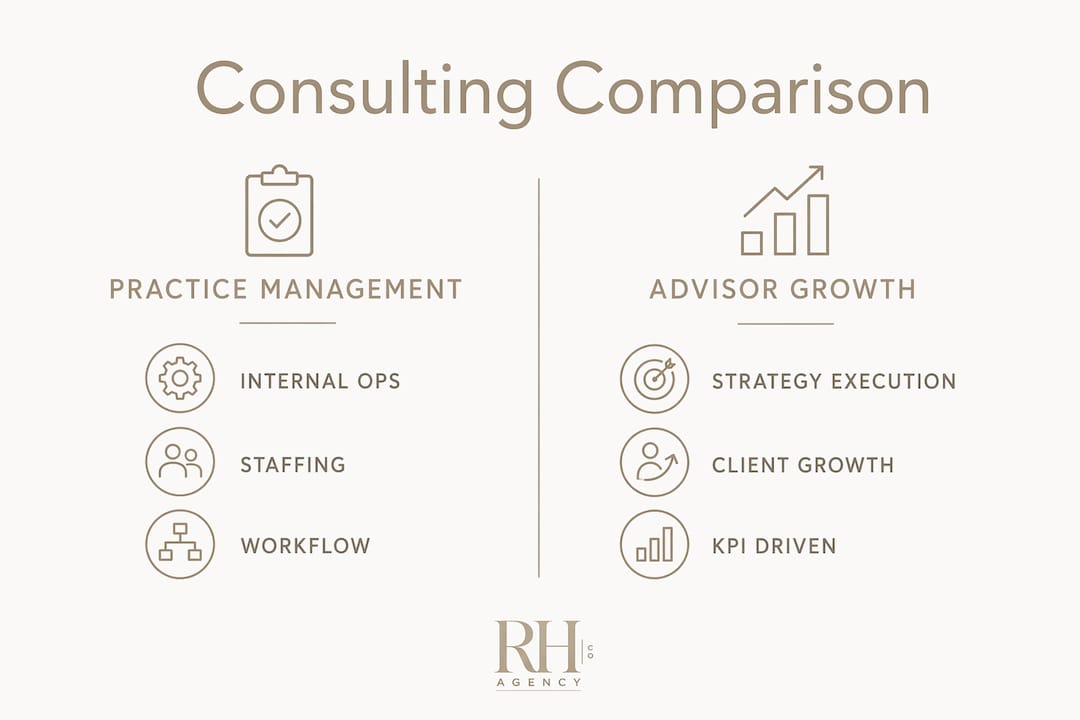
The distinction between advisor growth consulting and practice management consulting is meaningful, and conflating the two leads advisors to choose the wrong service for their situation.
Practice management consulting focuses on the internal operations of a financial advisory firm: staffing models, workflow design, compliance processes, and service delivery efficiency. Growth consulting, by contrast, focuses on expanding the practice outward. The goal is more clients, higher revenue, and increased practice value, not just a cleaner back office.
BlackRock's business consulting program illustrates how far the scope of growth consulting extends. It includes strategic consulting, industry insights, leadership development, and specialized client engagement formats designed to accelerate both organic and inorganic growth. That scope goes well beyond what traditional practice management addresses.
The table below outlines the core differences:
| Dimension | Practice management consulting | Advisor growth consulting |
|---|---|---|
| Primary focus | Internal operations and efficiency | Client acquisition and revenue growth |
| Engagement length | Project-based or ongoing retainer | Structured 18-month programs |
| Key deliverables | Workflow design, staffing models | Growth roadmap, KPI dashboards, milestones |
| Accountability model | Advisor-driven | Consultant-led with defined checkpoints |
| Scope | Operations and compliance | Strategy, marketing, leadership, execution |
General strategy consulting differs from both. A strategy consultant delivers a report. An advisor growth consultant stays through execution, which is the harder and more valuable part. Disciplined execution with accountability makes the difference between growth ideas and real business results.
What are the key benefits of advisor consulting services?
The benefits of advisor consulting services are measurable, not theoretical. Advisors in AssetMark's growth consulting program are expected to grow 18 to 20% above their historical trendline. That figure represents structured, organic growth driven by prioritized execution, not market tailwinds or luck.
The most significant benefits advisors report include:
- Increased practice value through sustained organic growth and improved client retention
- Sharper client acquisition driven by defined outreach strategies and accountability to activity metrics
- KPI discipline that converts vague growth goals into operating cadences with milestone-based tracking
- Leadership development that prepares advisors to scale their teams, not just their client books
- Expanded service delivery through specialized client engagement formats and industry insights
The accountability mechanism deserves particular attention. Most advisors already know what they should be doing to grow. The gap is execution. Growth consulting closes that gap by embedding a consultant who reviews progress, asks hard questions, and prevents the common pattern of deprioritizing growth work when client service demands spike.
"Growth consulting services increasingly include leadership development and client engagement strategies to accelerate both organic and inorganic growth beyond traditional practice management." — BlackRock Business Consulting
Advisors who treat growth consulting as a passive service miss most of the value. The programs work because they demand active participation, not just enrollment.
How to improve advisor growth through consulting: practical preparation steps
Knowing how to improve advisor growth through a consulting engagement requires preparation before the first session, not after. Advisors who arrive at their readiness assessment with clear data and defined goals compress the roadmap development phase and get to execution faster.
Follow these steps to maximize your consulting engagement from day one:
- Audit your current growth metrics. Pull your 12-month client acquisition numbers, average revenue per client, and referral sources before the assessment begins.
- Identify your top three growth constraints. Capacity, marketing, or conversion? Knowing this in advance focuses the roadmap on real problems.
- Commit the time. An 18-month engagement requires consistent participation. Block recurring time for consultant reviews before the program starts.
- Align your team. If you have staff, brief them on the engagement goals. Operational misalignment at the team level kills growth initiatives before they gain traction.
- Define what success looks like. Set a specific revenue or client count target for month 18. Vague goals produce vague results.
Advisor development strategies that work share one trait: they prioritize a small number of high-impact initiatives over a long list of good ideas. Organic growth through focused priorities and sustained commitment is the model that produces compounding results.
Pro Tip: Ask your growth consultant to build your KPI dashboard before the roadmap is finalized. Seeing the metrics you will be held to often clarifies which initiatives actually matter and which ones are distractions.
Key takeaways
Advisor growth consulting works because it combines structured assessment, prioritized roadmaps, and disciplined 18-month execution with embedded accountability that converts growth goals into measurable results.
| Point | Details |
|---|---|
| Structured engagement model | Growth consulting follows a three-phase process: assessment, roadmap, and disciplined execution over 18 months. |
| Measurable growth outcomes | AssetMark participants grow 18 to 20% above their historical trendline through structured organic growth. |
| Distinct from practice management | Growth consulting focuses on client acquisition and revenue expansion, not internal operations. |
| Accountability drives results | KPI dashboards and milestone reviews turn subjective goals into operational metrics with real checkpoints. |
| Preparation accelerates outcomes | Advisors who enter with clear baseline data and defined goals compress the roadmap phase and execute faster. |
Why execution discipline is the real differentiator in 2026
Most financial advisors I work with do not have a strategy problem. They have an execution problem. They know they should be building referral systems, improving their client onboarding experience, and developing their team's capacity. What they lack is the structure and external accountability to actually do it consistently.
That is what makes advisor growth consulting genuinely valuable in 2026. The market is crowded with strategic advice. What is rare is a service that stays through implementation, reviews your dashboard every month, and asks why the numbers are not moving. That friction is productive. It is the thing that separates advisors who grow from advisors who plan to grow.
I have also seen advisors underestimate the operational load that growth consulting creates. When you commit to executing a growth roadmap, you generate more marketing activity, more client meetings, more follow-up, and more administrative work. Advisors who do not have operational support in place often stall in the execution phase, not because the strategy is wrong, but because their back office cannot keep up. Pairing growth consulting with solid operational support for advisors is not optional if you want the program to deliver its full potential.
The advisors who get the most from these programs treat the consultant as a partner, not a vendor. They show up prepared, they do the work between sessions, and they use the accountability structure as a feature, not a burden.
— Jessica
How The Right Hand Agency Co supports advisors through growth
Financial advisors in growth consulting programs generate more work, not less. More client outreach, more marketing coordination, more calendar management, and more follow-up. The Right Hand Agency Co provides the operational backbone that keeps execution moving when your practice scales faster than your capacity.
From executive assistant services that handle scheduling, communications, and administrative follow-through, to marketing and CRM coordination that supports your client acquisition systems, The Right Hand Agency Co works alongside your growth consulting engagement to make sure nothing falls through the cracks. You focus on the strategy and client relationships. We handle the operational execution that keeps the momentum going. Explore how The Right Hand Agency Co supports financial advisors and RIAs who are serious about scaling without adding full-time overhead.
FAQ
What is advisor growth consulting in simple terms?
Advisor growth consulting is a structured service that helps financial advisors grow their practice through readiness assessments, customized roadmaps, and 18 months of disciplined execution support with built-in accountability.
How long does an advisor growth consulting engagement typically last?
Most programs, including AssetMark's model, run 18 months. This timeline allows for roadmap development, phased execution, and milestone-based course corrections that produce sustained results.
How does advisor growth consulting differ from hiring a business coach?
Business coaching is typically ongoing and open-ended. Advisor growth consulting follows a defined structure with KPI dashboards, milestone tracking, and a specific growth outcome as the target, making it more accountable and measurable.
What results can advisors expect from growth consulting services?
Advisors in structured programs like AssetMark's report growing 18 to 20% above their historical trendline, driven by prioritized organic growth initiatives and consistent execution discipline.
Do advisors need operational support alongside growth consulting?
Yes. Growth consulting increases activity volume across marketing, client acquisition, and administration. Advisors without operational support in place often stall during execution because their back office cannot absorb the added workload.