
TL;DR:
- A business consultant diagnoses organizational challenges and converts data into actionable decisions to improve performance. They follow a structured process from analysis and diagnosis to strategy design and implementation support, ensuring measurable outcomes. Companies hire consultants for expertise, capacity, objectivity, and speed to accelerate strategic initiatives that internal teams cannot achieve alone.
A business consultant is a professional who diagnoses operational and strategic challenges within organizations, recommends data-driven solutions, and helps implement changes that improve performance and growth. The role spans strategy, operations, finance, technology, and organizational design. At its core, what a business consultant does is convert raw data and structured analysis into decisions your leadership team can act on with confidence.
What does a business consultant do day to day?

The daily work of a business consultant follows a structured arc: diagnose, recommend, and support implementation. Each phase requires a different skill set, and the best consultants move fluidly between all three.
Here is what that looks like in practice:
- Current-state analysis. Consultants collect data from interviews, process documentation, and financial records to build a defensible fact base before drawing any conclusions. Superficial inputs produce weak recommendations, so this phase is never rushed.
- Root-cause diagnosis. Using structured frameworks and quantitative analysis, consultants identify the actual source of a problem rather than treating symptoms. A revenue decline, for example, may trace back to a pricing model, a sales process gap, or a product-market fit issue.
- Decision-grade deliverables. Consultants produce executive presentations and written reports covering findings, recommendations, financial projections, cost-benefit analysis, and risk assessments. These are not slide decks for show. They are the documents your leadership team uses to make high-stakes decisions.
- Future-state design. Consulting responsibilities include strategy and execution design before rollout. That means designing new operating models, organizational structures, or process flows based on diagnostic findings.
- Implementation support. When engaged through delivery, consultants support change management, track progress against KPIs, and adjust plans when reality diverges from the model.
Pro Tip: Ask any consultant you are evaluating to show you a sample deliverable. The quality of their output documents tells you more about their rigor than any sales conversation.
Why do companies hire business consultants?
The reasons companies bring in outside consultants are more specific than most people assume. Companies hire consultants to fill gaps in expertise, bandwidth, or objectivity. They are not a sign of internal weakness. They are a deliberate choice to accelerate outcomes on problems that matter.
"A consultant who optimized supply chains for one company can apply those lessons to others in different sectors." This cross-industry pattern recognition is something no internal hire can replicate at the same speed.
The most common drivers behind a consulting engagement include:
- Expertise gaps. Your team may be excellent at running the business but lack the specialized knowledge required for a specific challenge, whether that is a market entry decision, a technology selection, or a financial restructuring.
- Bandwidth constraints. Critical projects stall when your best people are already at capacity. Consultants provide on-demand specialized capacity without the overhead of a permanent hire.
- Objective perspective. Internal teams develop blind spots over time. An outside advisor surfaces assumptions your organization has stopped questioning. This is particularly valuable before major strategic decisions.
- Speed. Consultants apply specialized knowledge quickly on time-sensitive problems rather than spending months building internal capability first.
- Validation. Leadership teams often have a direction in mind but need a structured, evidence-based case to align the board, investors, or senior stakeholders. Consultants build that case.
Understanding why CEOs engage external consultants often comes down to one word: clarity. Consultants reduce uncertainty through structured fact-finding, enabling leadership to make informed decisions rather than relying on assumptions.
How are consulting engagements structured?
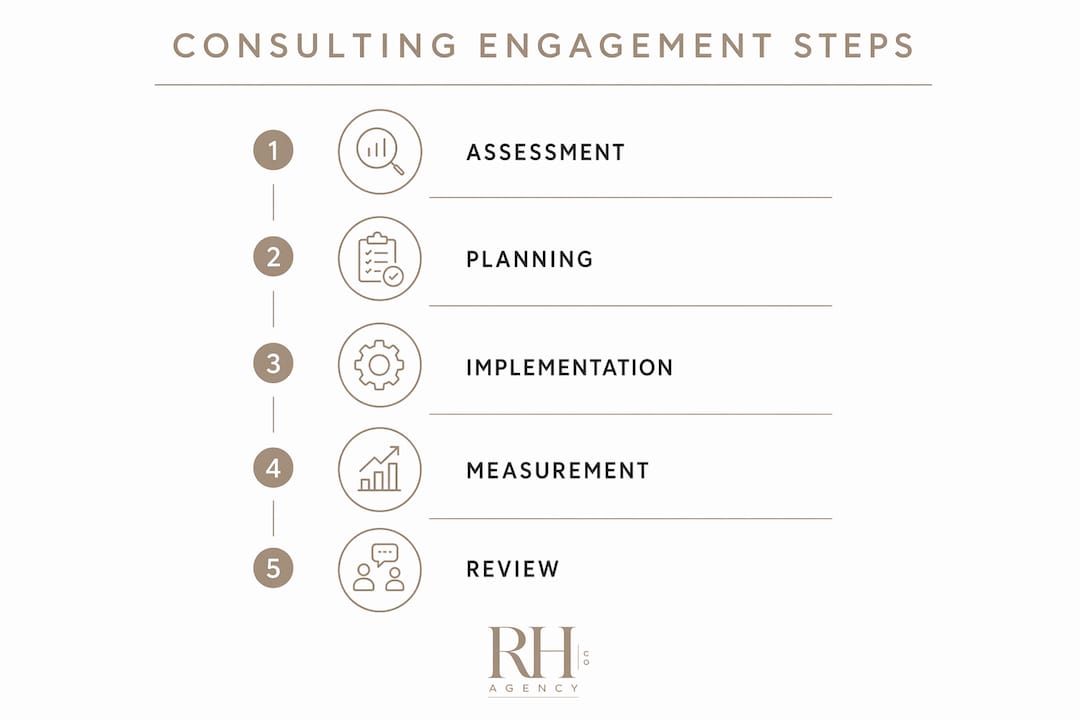
A consulting engagement without clear structure is a consulting engagement that will disappoint. The best-run projects define outcomes, deliverables, KPIs, and acceptance criteria before work begins.
| Phase | What happens |
|---|---|
| Assessment | Data collection, stakeholder interviews, process mapping, and baseline measurement |
| Diagnosis | Root-cause analysis, opportunity sizing, and prioritization |
| Design | Future-state process, operating model, or organizational structure development |
| Delivery | Implementation support, change management, training, and communication |
| Tracking | KPI monitoring, progress reporting, and plan adjustment |
Effective consulting requires explicit deliverables and a governance cadence to manage scope, demonstrate value, and provide clarity on progress and completion. A well-structured statement of work defines outcomes, deliverables with acceptance criteria, reporting cadence, governance meeting schedules, and a change control process.
Measurement is not an afterthought in well-run engagements. Measurement design is treated as a formal deliverable, with baselines set early so progress can be verified and plans adjusted quickly when needed.
Consulting engagements also vary in format. Formats include rapid discovery, fixed milestones, sprint-based delivery, and ongoing monthly advisory. A discovery engagement might run four to six weeks and produce a prioritized opportunity map. A retainer advisory model provides ongoing strategic support without a defined end date. Knowing which format fits your situation is part of how you get value from the relationship.
Pro Tip: Before signing any consulting agreement, confirm that phase completion is defined by acceptance criteria, not just calendar dates. Engagements that only deliver reports without supporting implementation risk failure because there is no accountability mechanism for real change.
How consultants improve operations and strategy in practice
The practical applications of consulting work are where the role becomes tangible for business owners and executives. Here is where the business consultant job description moves from abstract to concrete:
- Workflow redesign. Consultants map current processes, identify bottlenecks and redundancies, and redesign workflows to reduce costs and cycle times. They deliver playbooks, dashboards, and pilot programs to embed new operating rhythms.
- Strategic prioritization. When you have more opportunities than capacity, a consultant builds the analytical framework to rank them by impact, feasibility, and strategic fit. This prevents the common trap of pursuing everything and executing nothing well.
- Change management. New processes fail without adoption. Consultants design training programs, communication plans, and stakeholder engagement strategies to make change stick.
- Technology advisory. Consultants evaluate technology options against business requirements rather than vendor marketing. They help you select and implement systems that align with your actual operating model.
- Executive governance support. For growing businesses, consultants help design decision-making structures, meeting cadences, and reporting frameworks that scale with the organization.
The benefits of executive consulting support compound over time when engagements are structured around measurable outcomes rather than deliverable volume.
Key takeaways
A business consultant's core value is converting structured analysis into decisions and operational changes that measurably improve organizational performance.
| Point | Details |
|---|---|
| Diagnosis before advice | Consultants build a fact base through data, interviews, and process mapping before recommending anything. |
| Decision-grade deliverables | Outputs include financial projections, risk assessments, and executive reports built for high-stakes decisions. |
| Structured engagement design | Effective engagements define outcomes, KPIs, acceptance criteria, and governance before work begins. |
| Variable-cost expertise | Consultants provide specialized capacity on demand without the overhead of a permanent hire. |
| Implementation accountability | Engagements that include delivery support and measurement plans produce more lasting results than report-only work. |
The gap between strategy and execution is where most businesses lose
I have worked alongside enough leadership teams to know that the most common consulting failure is not bad advice. It is advice that never gets implemented. The report lands, the leadership team nods, and then the next quarter's urgencies swallow the recommendations whole.
The consultants who deliver real value treat implementation as part of their job description, not a handoff. They sit in the governance meetings. They track the KPIs. They push back when the organization starts reverting to old behavior. That kind of partnership requires a different relationship than the traditional "here is your strategy deck, good luck" model.
What I have also seen is that business owners often underestimate how much of a consultant's value comes from the questions they ask, not the answers they bring. A skilled consultant forces your organization to articulate assumptions it has never written down. That process alone surfaces problems that no amount of internal discussion had uncovered.
If you are considering bringing in a consultant, learn how to manage that relationship effectively before the engagement starts. The businesses that get the most from consulting are the ones that treat it as a structured collaboration, not a delegation of thinking.
— Jessica
How The Right Hand Agency Co can support your next consulting initiative

The Right Hand Agency Co provides executive assistant and operations consulting services designed to complement strategic consulting work. When a consulting engagement surfaces new priorities, your leadership team needs the operational bandwidth to act on them. That is exactly where we come in. From CRM implementation and project management systems to marketing coordination and administrative support, The Right Hand Agency Co gives you the capacity to execute without adding full-time overhead. If you are ready to put your consulting recommendations into motion, explore how our business operations support can help your team move faster and with more focus.
FAQ
What is the primary role of a business consultant?
A business consultant diagnoses organizational problems, recommends solutions, and supports implementation across strategy, operations, finance, and technology. The role centers on converting structured analysis into decisions and changes that improve performance.
How is a business consultant different from a business advisor?
A business consultant typically works on defined engagements with specific deliverables, KPIs, and acceptance criteria. A business advisor often provides ongoing, informal guidance without the same structured accountability framework.
What should a consulting engagement include?
A well-structured engagement defines outcomes, deliverables, acceptance criteria, KPIs, a reporting cadence, and a governance meeting schedule before work begins. Measurement baselines should be set in the first phase, not after recommendations are delivered.
When should a business owner hire a consultant?
Hire a consultant when your organization faces a high-stakes decision, a capability gap, a capacity constraint, or a performance problem that internal teams have not been able to resolve. The faster you need results, the stronger the case for outside expertise.
How do you measure the value a consultant delivers?
Value is measured against the KPIs and baselines established at the start of the engagement. Consultants who treat measurement design as a formal deliverable make it straightforward to verify impact and justify the investment.