
TL;DR:
- External consultants offer CEOs objectivity, access to cross-industry insights, and specialized skills crucial for strategic decisions. Research proves they deliver measurable improvements in management practices and long-term growth, especially when institutionalized into ongoing management routines. Their political and psychological roles help reduce resistance and facilitate smoother implementation of difficult organizational changes.
External consultants are defined as independent professionals who provide specialized expertise, objective analysis, and strategic guidance to organizations without the conflicts of interest that shape internal teams. CEOs need external consultants because internal teams, no matter how talented, are shaped by the same assumptions, politics, and blind spots that created the problem in the first place. The benefits of external consultants span from unbiased decision validation to measurable productivity gains, and the research supporting their value is stronger than most executives realize.
Why CEOs need external consultants more than ever in 2026
The core advantage external consultants deliver is objectivity. Internal teams carry loyalty to colleagues, fear of political fallout, and attachment to past decisions. An outside advisor carries none of that weight. According to research on external vs. internal consultants, the primary trade-off is objectivity versus internal knowledge, and for CEOs facing high-stakes decisions, objectivity wins.

External consultants also bring cross-industry pattern recognition that no single internal team can accumulate. A consultant who has worked with 40 companies across three sectors has seen failure modes your team has never encountered. That depth of exposure translates directly into faster diagnosis and better-calibrated recommendations.
Three specific advantages stand out:
- Unbiased perspective. Consultants have no stake in protecting existing processes, teams, or strategies. They can say what needs to be said.
- Specialized skills on demand. CEOs hiring advisors for a specific initiative, such as a market entry or operational overhaul, get deep expertise without a permanent hire.
- Legitimacy for difficult decisions. When a CEO needs to restructure a division or exit a market, an external recommendation provides cover and credibility that an internal memo cannot.
Pro Tip: Before engaging any consultant, write down the three questions you most need answered. If a consultant cannot address all three directly, they are not the right fit for this engagement.
What does the research actually say about consulting effectiveness?
The evidence for consulting impact is not anecdotal. A World Bank study on management consulting found that group-based consulting delivers improvements of 8 to 10 percentage points in management practices, at roughly one-third the cost of individual consulting. That cost efficiency matters for CEOs evaluating the return on advisory services.
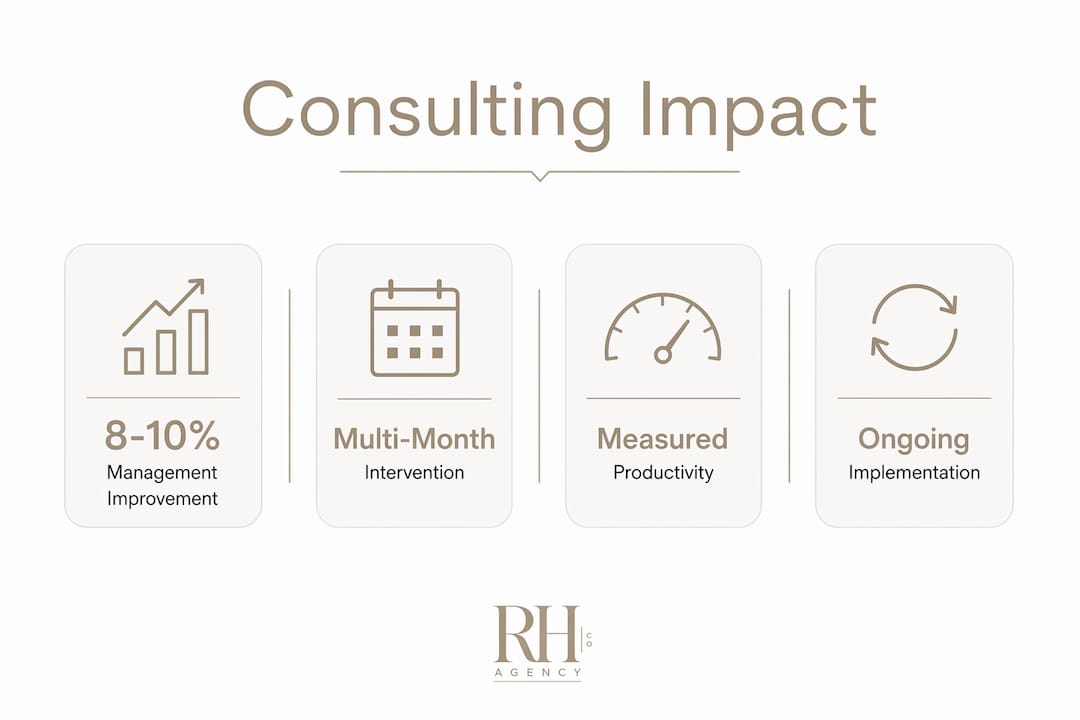
Stanford and World Bank researchers found that multi-month consulting interventions led to measurable total factor productivity gains in treated firms compared to controls. This is not a soft metric. Productivity gains show up in output, margins, and firm size over time. The same World Bank research tracked firms over three years and found that group-based consulting participants grew larger and generated more sales than non-participants.
The table below summarizes the key research findings on consulting effectiveness:
| Study | Finding | Implication for CEOs |
|---|---|---|
| World Bank (group consulting) | 8 to 10 point improvement in management practices | Group formats deliver measurable gains at lower cost |
| World Bank (firm growth) | Treated firms grew larger over three years | Consulting impact compounds beyond the engagement period |
| Stanford/World Bank (productivity) | Measurable total factor productivity gains in treated plants | Consulting improves operational output, not just strategy |
One critical caveat: consulting recommendations drive value only when converted into ongoing management practices, not treated as one-off advice. The CEO's job is to institutionalize what the consultant surfaces.
How do consultants change the politics inside your organization?
The political and psychological functions of consulting are underappreciated and rarely discussed openly. When a CEO needs to make an unpopular call, an external consultant can share accountability for that decision. The recommendation did not come from the CEO alone. It came from an independent expert. That framing reduces internal resistance and makes execution smoother.
Steven Strauss, writing on why corporations hire consultancies, identifies this directly: consultants serve political and psychological roles that are as important as their technical contributions. In turnaround situations especially, the consultant's real value often lies in changing the organizational frame, not just delivering a report.
The psychological dimension extends to the CEO personally. Senior partners at major consulting firms frequently serve as confidential sounding boards, providing the kind of candid feedback that direct reports are reluctant to give. This mentorship and emotional support function is rarely listed in a consulting proposal, but executives who have used it describe it as one of the most valuable parts of the relationship.
Key organizational benefits of this dynamic include:
- Reduced internal conflict when implementing structural changes
- Shared accountability that protects team morale during difficult transitions
- A trusted, confidential channel for the CEO to pressure-test thinking before committing
"Outsiders can effectively share blame for unpopular decisions and facilitate smoother execution." — Steven Strauss
When and how should CEOs engage external consultants?
Timing determines whether a consulting engagement succeeds or wastes budget. The three highest-value moments to bring in outside expertise are: before a major strategic inflection point such as an acquisition or market expansion; during a period of organizational stagnation where internal teams have lost momentum; and when a CEO faces a decision with consequences that outpace the team's direct experience.
Effective consulting engagements share four characteristics that separate high-impact work from expensive reports that collect dust:
- Defined scope. The engagement addresses a specific question or problem, not a vague mandate to "improve the business."
- Bounded timeline. A clear end date prevents dependency and forces both parties to prioritize.
- CEO involvement. The CEO participates actively, not as a passive recipient of recommendations.
- Implementation capability. The organization has the capacity to act on findings before the engagement closes.
Consulting is most effective when used to improve decision quality, not as a substitute for leadership. A consultant who is brought in to delay a hard call will produce a report that delays the hard call. The CEO still owns the decision.
Pro Tip: Structure every consulting engagement with a 30-day implementation review built into the contract. This forces accountability on both sides and dramatically increases the odds that recommendations become practice.
Effective strategy advisors to CEOs earn trust by focusing on the CEO's specific problems and integrating insights across domains. The best engagements feel less like vendor relationships and more like having a senior partner in the room who has no agenda except getting the answer right.
Key takeaways
External consultants deliver measurable management improvements, reduce organizational resistance, and give CEOs the objective perspective that internal teams structurally cannot provide.
| Point | Details |
|---|---|
| Objectivity is the core value | External consultants carry no internal loyalties, making their analysis more credible and harder to dismiss. |
| Research confirms measurable gains | World Bank studies show 8 to 10 point improvements in management practices and long-term firm growth. |
| Political functions matter as much as expertise | Consultants reduce internal resistance and share accountability for difficult decisions. |
| Timing and scope determine ROI | Engage before inflection points with a defined scope and active CEO involvement for maximum impact. |
| Recommendations must become practice | One-off advice produces no lasting value. Institutionalizing findings is the CEO's responsibility. |
What I've learned from watching CEOs use external advisors well and poorly
I have worked alongside enough executives to know that the CEOs who get the most from external consultants treat them as thinking partners, not answer machines. The ones who struggle tend to hire consultants to validate a decision they have already made. That is an expensive way to buy confirmation bias.
The most effective engagements I have seen share one quality: the CEO came in genuinely uncertain and left with a clearer frame, not just a slide deck. That requires intellectual honesty that is harder than it sounds at the executive level, where admitting uncertainty can feel like a liability.
What I find most interesting is how often the value shows up in places the CEO did not expect. A consultant brought in to analyze pricing ends up surfacing a team alignment problem. An operational review reveals a strategy gap. That cross-domain visibility is exactly what strategic planning for business leaders requires, and it is almost impossible to generate from inside the organization.
The right external advisor does not make you dependent. They make your team sharper.
— Jessica
How The Right Hand Agency Co supports CEOs with operational consulting
CEOs who recognize the value of external expertise often discover that the gap between strategy and execution is where growth stalls. The Right Hand Agency Co provides business operations consulting and executive support designed specifically for leaders who need capable, experienced partners without the overhead of full-time hires.

From CRM implementation and project management systems to executive assistant services and marketing coordination, The Right Hand Agency Co functions as the operational backbone that lets CEOs focus on decisions that require their direct attention. If you are ready to bring in external expertise that translates directly into execution, The Right Hand Agency Co is built for exactly that.
FAQ
Why do CEOs hire external consultants instead of relying on internal teams?
External consultants provide objectivity that internal teams cannot. They carry no loyalty to existing processes or colleagues, which makes their analysis more credible and their recommendations easier to act on.
What does research say about the ROI of management consulting?
World Bank research found that consulting interventions improve management practices by 8 to 10 percentage points and produce measurable productivity gains in treated firms. Group-based consulting delivers similar results at roughly one-third the cost of individual engagements.
When is the best time for a CEO to hire a business consultant?
The highest-value moments are before major strategic decisions, during periods of organizational stagnation, or when a decision exceeds the direct experience of the internal team. Engaging before a crisis produces better outcomes than reacting to one.
How do external consultants help with internal organizational resistance?
Consultants serve as neutral third parties who can share accountability for difficult decisions, reducing the political friction that makes unpopular changes hard to execute. This function is as valuable as their technical expertise.
What makes a consulting engagement fail?
Engagements fail when the scope is vague, the CEO is not actively involved, or the recommendations are never converted into ongoing management practices. A well-structured engagement with a defined timeline and clear deliverables dramatically reduces these risks.