
TL;DR:
- Executive coaching is a confidential, structured partnership focused on behavioral change and self-awareness for leaders. It typically lasts 6 to 12 months, involving regular sessions that foster lasting leadership improvements and high ROI. Success depends on the leader’s readiness to accept honest feedback and commit to ongoing development.
Executive coaching is defined as a structured, confidential partnership between a trained coach and a senior leader, designed to improve leadership effectiveness through sustained behavioral change and increased self-awareness. Engagements typically run 6 to 12 months with sessions every two to three weeks, creating enough time to rewire ingrained habits rather than produce temporary insights. Organizations like the International Coaching Federation, BetterUp, and FranklinCovey have formalized coaching frameworks that consistently show measurable results. When aligned with clear business goals, executive coaching produces some of the highest returns of any leadership investment available.
What is executive coaching and why does it matter?
Executive coaching is a professional development practice where a certified coach works one-on-one with a leader to close the gap between current behavior and the leadership standard the role demands. The focus is not on fixing a broken person. It is on helping a capable leader perform at a higher level by identifying blind spots, challenging assumptions, and building new habits.

The value of an executive coach lies in the quality of questions asked, not the advice given. A skilled coach helps leaders uncover patterns they cannot see from inside their own experience. This is especially relevant for executives who operate in environments where direct, honest feedback is rare. Most senior leaders receive filtered information from their teams, which creates a distorted picture of their actual impact.
Executive coaching also bridges the knowing-doing gap in leadership development. Most leaders know what good leadership looks like. The challenge is consistently applying it under pressure, in conflict, and at scale.
Key benefits of executive coaching for leaders
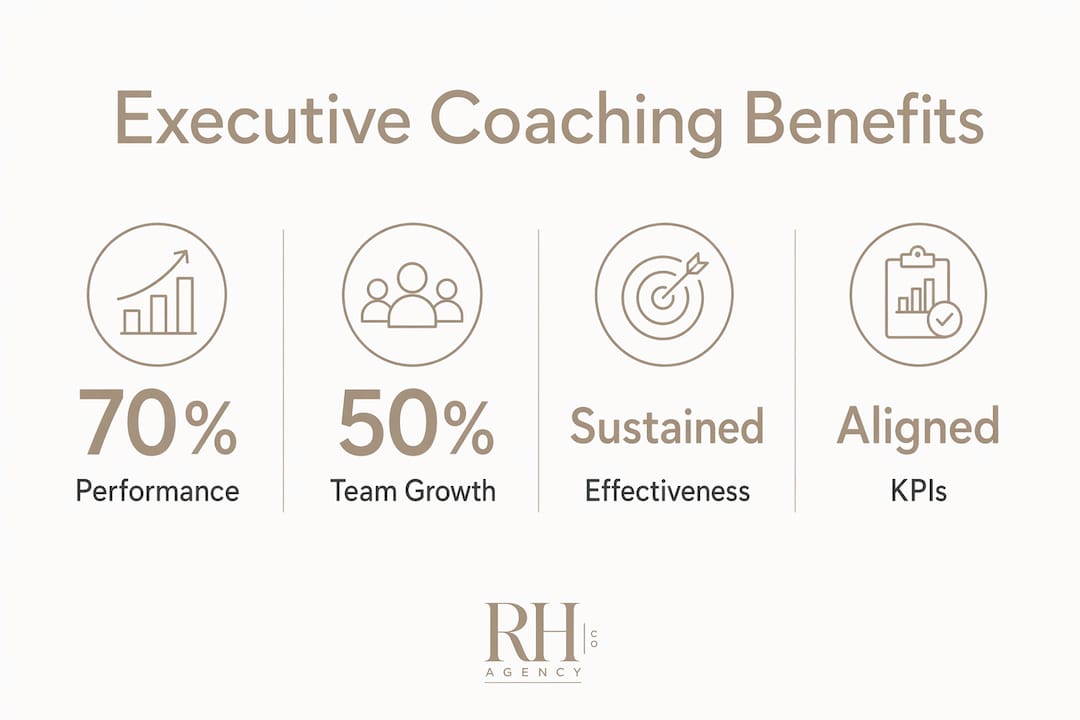
Structured coaching programs can drive up to 70% improvement in individual leader performance and up to 50% in team performance. Those are not incremental gains. They represent a meaningful shift in how a leader shows up, makes decisions, and influences the people around them.
The financial case is equally strong. Executive coaching programs deliver 2x to 7x ROI on the initial investment, making them one of the most cost-effective leadership development tools available. For context, a single poor leadership decision at the executive level can cost far more than a full year of coaching.
Beyond the numbers, the most commonly reported benefits include:
- Stronger self-awareness and the ability to recognize how personal behavior affects team culture
- Improved emotional intelligence, which directly impacts conflict resolution and retention
- Sharper decision-making under pressure and in ambiguous situations
- Greater resilience when navigating organizational change or performance pressure
- Clearer communication that aligns teams around shared goals
Leaders who complete structured coaching show sustained improvements in leadership effectiveness and team engagement, not just short-term behavior shifts.
Pro Tip: Align your coaching goals directly with your business KPIs from day one. A coach who understands your revenue targets, team structure, and operational bottlenecks will help you make faster, more relevant progress than one working from generic leadership frameworks.
Executive coaching vs mentoring, consulting, and therapy
These four practices are frequently confused, and the distinction matters when you are deciding where to invest your development time.
| Practice | Primary method | Who drives the agenda | Outcome focus |
|---|---|---|---|
| Executive coaching | Powerful questions | The leader being coached | Behavioral change and self-awareness |
| Mentoring | Experience sharing | The mentor | Knowledge and career guidance |
| Consulting | Analysis and recommendations | The consultant | Solutions and deliverables |
| Therapy | Psychological exploration | The therapist | Emotional healing and mental health |
Coaching asks questions; mentoring shares experience; consulting provides deliverables. Each has its place, but they are not interchangeable. A consultant will tell you what to do. A mentor will tell you what worked for them. A coach will help you figure out what works for you.
Therapy is also distinct. Executive coaching differs from therapy by focusing on present and future leadership behavior rather than exploring psychological roots or past trauma. If a leader is dealing with clinical anxiety or unresolved personal issues that are affecting performance, therapy is the right starting point.
Leadership coaching and executive coaching overlap significantly. The main distinction is scope. Leadership coaching can apply to managers at any level, while executive coaching specifically targets leaders whose decisions have system-level consequences that they cannot fully see from their own vantage point.
Pro Tip: If you are unsure whether you need a coach or a consultant, ask yourself this: do you need someone to give you answers, or do you need to become better at finding your own? If it is the latter, coaching is the right tool. For external consulting support, the differences between these roles are worth understanding before you hire.
How does executive coaching work in practice?
Most engagements follow a predictable structure, even when the content is highly personalized. Here is the typical sequence:
- Intake and contracting. The coach and leader agree on goals, confidentiality terms, and how success will be measured. Organizational sponsors may be involved at this stage.
- Assessment. Tools like 360-degree feedback, psychometric assessments, and structured interviews surface patterns the leader may not recognize in themselves.
- Coaching sessions. Held every two to three weeks, sessions focus on real challenges the leader is currently navigating. There are no scripts or generic exercises.
- Field practice. Between sessions, the leader applies new behaviors in their actual work environment and brings observations back to the next session.
- Review and close. At the end of the engagement, progress is measured against the original goals, and the leader builds a plan to sustain the changes independently.
Executive coaching modes include developmental, performance, transition, and team coaching, often blended depending on what the leader needs at a given stage. A leader moving into a new role may need transition coaching first, then developmental coaching as they settle in.
Organizational support also matters. Coaching works best when the leader's manager and HR partner understand the engagement, respect its confidentiality, and create space for the leader to practice new behaviors without immediate judgment.
Types of executive coaching and how to choose the right fit
Not all executive coaching looks the same. The right type depends on your role, your specific challenges, and where you are in your career.
- Individual executive coaching is the most common format. One coach, one leader, focused on that leader's specific behavioral goals.
- Team executive coaching works with a leadership team as a unit, addressing group dynamics, communication patterns, and collective decision-making.
- Career transition coaching supports leaders moving into new roles, industries, or levels of authority where their existing habits may not transfer cleanly.
- Performance coaching addresses a specific gap, often triggered by feedback from a board, CEO, or HR review.
- ADHD leadership coaching is a growing specialization for executives managing attention and executive function challenges in high-demand roles.
When selecting a coach, prioritize fit over credentials. A coach with deep experience in your industry or leadership context will ask better questions than a generically certified coach who does not understand your world. The career development resources available to corporate professionals increasingly include coaching as a core component, not an optional add-on.
Key takeaways
Executive coaching produces lasting leadership change only when the leader brings honest challenges, commits to the full engagement, and aligns coaching goals with real business outcomes.
| Point | Details |
|---|---|
| Core definition | Executive coaching is a structured, confidential partnership focused on behavioral change and self-awareness. |
| Measurable ROI | Coaching delivers 2x to 7x return on investment and up to 70% improvement in individual performance. |
| Not consulting or mentoring | Coaching develops a leader's own capacity through questions, not advice or solutions. |
| Engagement structure | Effective engagements run 6 to 12 months with sessions every two to three weeks. |
| Choosing the right type | Match coaching format to your specific role, challenge, and career stage for the best results. |
The part most articles skip
I have worked alongside enough executives to say this plainly: the leaders who get the most from coaching are not the ones who need it most. They are the ones who are most ready for it.
Readiness means being willing to hear things that are uncomfortable. It means showing up to sessions with real problems, not polished summaries. The critical success factor for coaching is the leader's willingness to accept candid feedback, not just positive affirmation. That sounds obvious. It is not easy in practice.
I have also seen leaders treat coaching as a quick fix. Six weeks, a few sessions, some reflection, done. That approach rarely produces lasting change. A structured engagement over months is what actually rewires leadership habits. One-off sessions are better than nothing, but they are not coaching in any meaningful sense.
The other thing worth saying: coaching is not a substitute for operational support. A leader can become more self-aware and still be buried in tasks that should not be on their plate. Coaching improves how you lead. It does not free up the hours you need to actually lead.
— Jessica
How The Right Hand Agency Co supports executive leaders
Coaching sharpens how you lead. But the hours you spend on administrative work, inbox management, and operational coordination are hours you cannot spend leading. The Right Hand Agency Co works directly with executives and small business owners to remove that friction.
Our executive assistant services are built for leaders who are serious about protecting their time and focus. From calendar management and project coordination to CRM organization and operational consulting, we handle the work that sits between you and your highest-value decisions. If you are investing in coaching to become a better leader, let us make sure your day-to-day operations actually support that goal. Visit The Right Hand Agency Co to learn how we work.
FAQ
What is the executive coaching definition?
Executive coaching is a structured, confidential partnership between a trained coach and a senior leader, focused on improving leadership effectiveness through behavioral change and self-awareness. It typically runs 6 to 12 months with sessions every two to three weeks.
Is executive coaching effective?
Yes. Research shows structured coaching programs can improve individual leader performance by up to 70% and deliver 2x to 7x return on investment. Leaders who complete full engagements show sustained improvements in communication, decision-making, and team engagement.
How is executive coaching different from mentoring?
Mentoring transfers experience from a more senior professional to a less experienced one. Executive coaching uses powerful questions to help the leader develop their own capacity to solve problems, without the coach providing direct advice or solutions.
How long does executive coaching take?
Most executive coaching engagements last 6 to 12 months, with sessions held every two to three weeks. Shorter engagements can produce awareness, but sustained behavioral change requires a longer structured commitment.
What types of executive coaching are available?
The main types include individual coaching, team coaching, career transition coaching, performance coaching, and ADHD leadership coaching. The right format depends on the leader's specific role, challenges, and development goals.