
TL;DR:
- Technology stack advisory firms diagnose organizations’ current tech environments, recommend aligned target architectures, and guide adoption to reduce complexity and improve outcomes. They deliver actionable roadmaps, risk assessments, and senior-led oversight, emphasizing process redesign over tool selection. Effective engagement relies on independence, ongoing relationship management, and integrating workflow improvements to maximize productivity and mitigate operational risks.
Technology stack advisory firms are specialized consultancies that diagnose an organization's layered technology environment, recommend a coherent target-state operating model, and guide adoption in ways that reduce complexity and align technology investments with business outcomes. For executives in financial and professional services, fragmented tech environments are not just an IT problem. They are a direct drag on productivity, decision-making, and growth. The role of technology stack advisory firms goes well beyond tool selection. These firms combine technical expertise, process redesign, and independent vendor-neutral advice to help leadership teams capture measurable gains without adding headcount.
What do technology stack advisory firms actually do?
Technology stack advisory firms operate at the intersection of technology, operations, and business strategy. Engagement structures typically range from two to five week strategy and architecture reviews to fractional CTO or CIO advisory engagements lasting three to twelve months. The output is not a vendor shortlist. It is a written roadmap, a risk assessment, and an executive presentation tied directly to business outcomes.

The diagnostic phase is where most of the real value is created. Advisors map your current technology architecture against your operating model to identify where the two are misaligned. In wealth management, for example, firms commonly operate tech stacks spanning 10+ systems, each with proprietary data formats that require manual exports or custom integrations just to produce a single client report. That kind of fragmentation is invisible until someone maps it.
Here is what a thorough diagnostic typically covers:
- Current-state architecture review: Every system, integration, and data flow is documented and assessed for business model fit.
- Gap and concentration analysis: Advisors identify where manual work, data silos, and single points of failure create operational risk.
- Benchmark comparison: Your stack is measured against peer firms and industry standards to surface inefficiencies that feel normal but are not.
- Data quality audit: Legacy inconsistencies during migration cause inherited problems, so advisors must address data remediation before recommending any new system.
Pro Tip: Ask any advisory firm you are evaluating to show you a sample diagnostic report before you sign. The quality of that document tells you more about their capabilities than any sales conversation.
What are the real benefits of working with tech stack advisors?
The most direct benefit is productivity. Deloitte predicts advisor productivity gains of 30% to 100% by 2032 through process redesign and supportive technology infrastructure. That range is wide because the outcome depends heavily on how willing the firm is to redesign its processes, not just replace its tools.
Beyond productivity, the benefits of tech stack advisors fall into three categories: visibility, risk reduction, and procurement leverage.
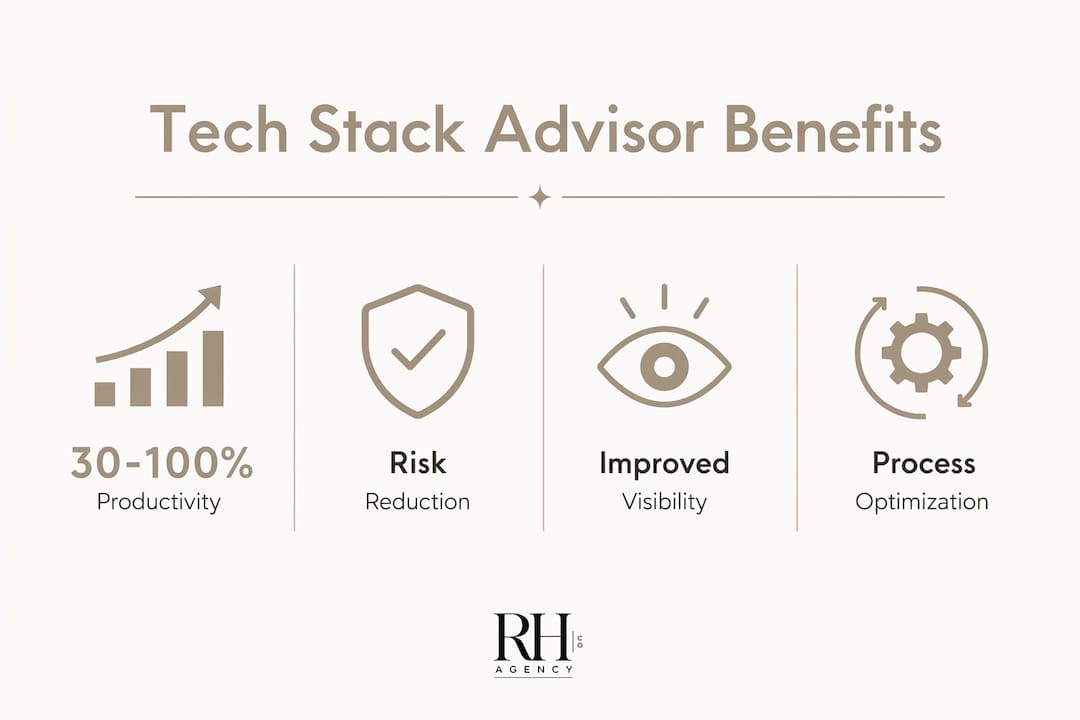
| Benefit | What it means for your business |
|---|---|
| Increased productivity | Shifting time from administration to client work through integration and normalization of data |
| Leadership visibility | Consolidated reporting replaces fragmented dashboards, giving executives a single source of truth |
| Risk mitigation | Technology due diligence produces risk assessments and integration roadmaps for M&A and governance decisions |
| Vendor-neutral procurement | Independent advisors negotiate without commission conflicts, improving contract outcomes |
| Ongoing fractional advisory | Fractional CTO or CIO support sustains long-term productivity beyond the initial engagement |
The vendor-neutral point deserves emphasis. When your advisor earns commissions from the platforms they recommend, the advice is compromised. Fee-based, senior-led consultancies that do not resell products are structured to give you recommendations that serve your business, not their revenue.
Pro Tip: Before any advisory engagement, ask directly: "Do you receive compensation from any vendor whose products you might recommend?" The answer should be an unambiguous no.
How advisory firms approach integration without adding complexity
The most common mistake executives make when optimizing their tech stack is treating integration as an addition problem. They add a new platform, a new dashboard, or a new automation layer, and then wonder why adoption fails. Integration is subtraction. The goal is fewer connections, fewer manual steps, and fewer places where data can break.
Effective technology stack consulting frames integration as an operating decision, not an IT project. That distinction matters because it changes who needs to be in the room. When integration is treated as IT, only technical staff are consulted. When it is treated as an operating decision, operations leaders, compliance teams, and client-facing staff all have input on what friction actually looks like day to day.
Here is how experienced advisory firms approach integration without creating new complexity:
- Map the friction first. Before recommending any new system, advisors document every manual step, workaround, and reconciliation task in the current workflow.
- Identify what to remove. The question is not "what should we add?" It is "what can we eliminate?" Proprietary data formats and manual exports are the first targets.
- Redesign the process before selecting the tool. Technology should support a redesigned workflow, not be layered on top of a broken one.
- Plan for organizational readiness. Technology adoption depends on advisor willingness and firm readiness, not just technical capability.
- Measure friction reduction, not feature count. Success is fewer manual steps and less reconciliation work, not more dashboards.
"Stack optimization fails when workflows increase complexity. Successful advisory reduces operational friction so that teams stop reverting to manual workarounds." — Operational friction and tech stack optimization
How to choose a technology stack advisory firm
The technology stack evaluation process for selecting an advisory partner starts with one non-negotiable criterion: independence. An advisory firm that resells vendor products or earns referral fees cannot give you unbiased guidance. That conflict is structural, not personal, and no amount of good intentions fixes it.
Beyond independence, here is what separates strong advisory firms from average ones:
Senior involvement. Effective advisory engagements keep senior principals directly responsible for deliverables from contract signing through executive briefing. If the partner sells the engagement and then hands it to a junior team, you are not getting what you paid for.
Cross-domain fluency. The best IT advisory firms understand capital markets, compliance, and operations, not just technology. A firm that can only speak to technical architecture will miss the business model implications of every recommendation it makes.
Defined deliverables. Written roadmaps, risk assessments, and executive presentations are the standard output of a credible engagement. If a firm cannot describe exactly what you will receive at the end of each phase, that is a red flag.
Flexible engagement models. Short diagnostic engagements (two to five weeks) are appropriate for firms that need a clear picture before committing to change. Fractional CTO or CIO advisory is better suited for firms that need ongoing support through a multi-year transformation. The right firm offers both and helps you choose based on your actual situation.
Pro Tip: Request references from firms at a similar stage of growth, not just the largest clients on the advisory firm's roster. The complexity of a $5 billion RIA is different from a $500 million practice, and the advisory approach should reflect that.
You can also explore practice management consulting as a complementary lens for evaluating how technology decisions connect to broader operational and service delivery goals.
Key takeaways
Technology stack advisory firms deliver the most value when they combine independent diagnosis, process redesign, and senior-led accountability into a single engagement model.
| Point | Details |
|---|---|
| Start with diagnosis | Map current architecture and data flows before recommending any new system or integration. |
| Independence is non-negotiable | Fee-based advisors without vendor commissions give recommendations that serve your business, not their revenue. |
| Integration means subtraction | Reducing manual steps and connections matters more than adding new tools or dashboards. |
| Senior involvement drives outcomes | Advisors who stay accountable from contract to delivery produce better results than junior-heavy teams. |
| Productivity gains are measurable | Deloitte projects 30% to 100% productivity gains through process redesign supported by the right technology infrastructure. |
Why most executives underestimate what advisory actually requires
From my work supporting executives and financial advisory firms at The Right Hand Agency Co, the most consistent mistake I see is treating technology stack advisory as a one-time project. Leaders bring in an advisory firm, receive a roadmap, and then try to execute it with the same internal team and the same habits that created the fragmented stack in the first place.
The firms that actually capture productivity gains treat advisory as an ongoing relationship. They use fractional CTO or CIO support to stay accountable to the roadmap, adjust when business conditions change, and build internal capability over time. The strategic planning discipline required to sustain that kind of engagement is not natural for most leadership teams. It has to be built deliberately.
The other thing I would push back on is the assumption that better tools solve the problem. They do not. The firms I have seen struggle most with technology are not using bad software. They are using good software badly, because no one redesigned the workflow before the new system went live. Advisory that skips process redesign is just expensive vendor selection.
— Jessica
How The Right Hand Agency Co supports technology advisory execution
Selecting the right advisory firm is only half the work. Executing the roadmap, coordinating vendors, managing implementation timelines, and keeping leadership informed requires operational capacity that most growing firms do not have sitting idle. The Right Hand Agency Co provides executive assistant services and operational consulting designed to fill exactly that gap. For financial advisors and professional services firms, our technology systems services cover CRM implementation, workflow design, and systems coordination so that advisory recommendations actually get built. If you are working through a technology transition and need a trusted operational partner to keep it moving, we can help without the overhead of a full-time hire.
FAQ
What is a technology stack advisory firm?
A technology stack advisory firm diagnoses an organization's current technology environment, recommends a target-state architecture aligned with business goals, and guides integration and adoption. Engagements range from short diagnostic reviews to ongoing fractional CTO or CIO advisory lasting up to twelve months.
How do advisory firms differ from IT consultants?
Technology consultants do more than recommend tools. They lead infrastructure planning, risk analysis, and lifecycle coordination across the full technology portfolio. IT consultants typically focus on implementation, while advisory firms focus on strategy and operating model alignment.
What should I look for when choosing a technology stack advisor?
Prioritize independence (no vendor commissions), senior-led delivery, and defined written deliverables such as roadmaps and risk assessments. Firms that offer both short diagnostic engagements and ongoing fractional advisory give you the most flexibility as your needs evolve.
How long does a technology stack advisory engagement take?
Strategy and architecture reviews typically take two to five weeks. Fractional CTO or CIO advisory engagements run three to twelve months depending on the scope of transformation required and the firm's readiness to adopt changes.
Why do technology stack optimization efforts fail?
Most failures occur when new systems add workflow steps instead of removing friction, causing teams to revert to manual workarounds. Successful advisory addresses process redesign and organizational readiness before any new technology is deployed.