
TL;DR:
- Restructuring consultants provide independent operational leadership, including cash flow management and stakeholder communication, to facilitate sustainable recovery. Their role involves hands-on interim management, strategic oversight, and building internal capabilities to ensure long-term stability. Engaging them early enhances success, fosters organizational independence, and distinguishes genuine turnaround efforts from temporary fixes.
Restructuring consultants are defined as external advisors who lead turnaround strategies, manage liquidity, and reposition distressed businesses for sustainable recovery. The role of consultants in restructuring goes well beyond advice. Firms like Alvarez & Marsal and FTI Consulting deploy teams that take operational control, build 13-week cash flow models, and negotiate directly with creditors. Their independence from internal politics is what makes them effective. Where internal management sees complexity and loyalty, a restructuring consultant sees root causes and solutions.
What functions do consultants perform during a restructuring?
The most effective restructuring consultants blend operational expertise with strategic leadership, often stepping into interim executive roles that directly influence daily decisions. This is not a passive advisory function. It is hands-on operational leadership.
The core tasks consultants perform fall into five categories:
- Cash flow forecasting. Consultants build granular 13-week models that give lenders and creditors a transparent view of liquidity. This tool is the standard deliverable in any distressed situation and forms the basis for every negotiation.
- Operational restructuring. Cost reduction, vendor renegotiation, and process improvement are executed quickly. Consultants identify inefficiencies that internal teams have normalized over years.
- Financial restructuring. With over $1.4 trillion in high-yield debt set for refinancing between 2026 and 2027, consultants are increasingly called on to facilitate out-of-court solutions before formal proceedings become necessary.
- Interim management. Consultants placed in Chief Restructuring Officer (CRO), interim CFO, or interim CEO roles carry clear governance mandates to stabilize operations and lead change.
- Stakeholder management. Building credibility with lenders, creditors, and boards is a core deliverable. Consultants translate operational plans into financial narratives that external stakeholders trust.
Pro Tip: Engage a restructuring consultant before you miss a debt covenant, not after. Early engagement gives the consultant time to build a credible plan rather than manage a crisis.
How do restructuring consultants differ from investment bankers?

This distinction matters because executives often confuse the two roles, leading to misaligned expectations and gaps in execution.
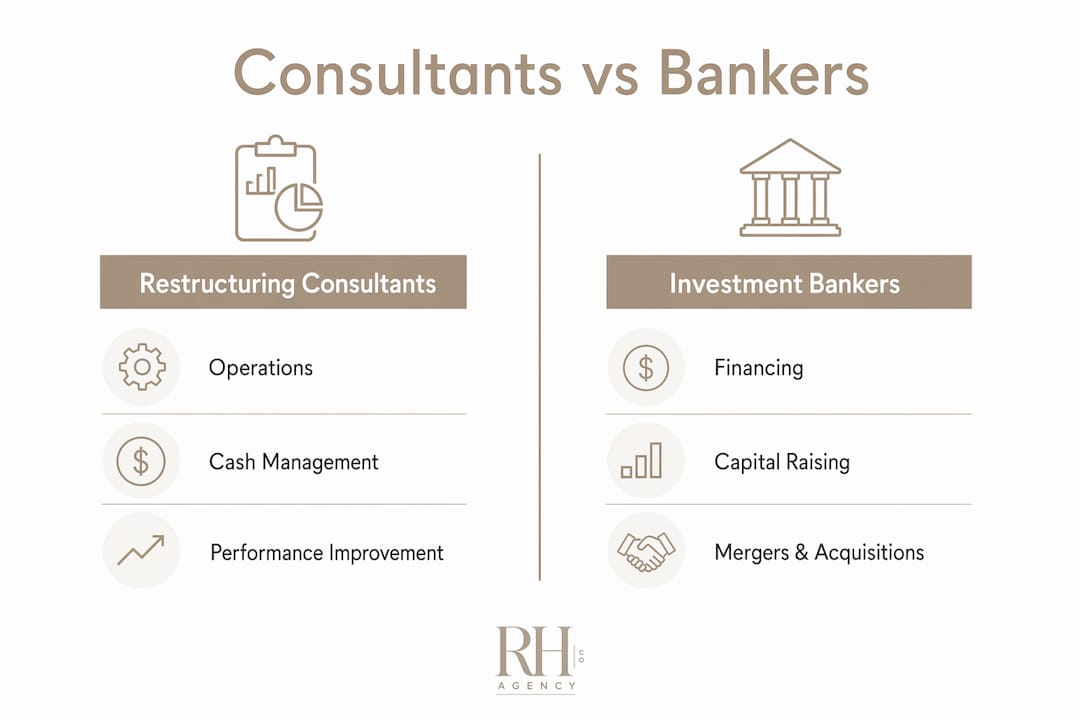
Consultants manage operational restructuring including cost reduction, cash management, and performance improvement. Investment bankers handle capital structure, creditor negotiations, and valuation. The two roles are complementary, not interchangeable.
| Dimension | Restructuring consultants | Investment bankers |
|---|---|---|
| Primary focus | Operations, cash flow, cost reduction | Capital structure, debt negotiations, valuation |
| Deliverables | 13-week cash flow model, operational plan | Financial model, term sheet, creditor proposal |
| Authority | Often hold interim executive titles | Advisory role without operational authority |
| Independence | Free from internal bias and history | Aligned with transaction outcome |
| Collaboration | Feed operational data to bankers | Use consultant outputs in financial models |
Turnaround consultants work in parallel with bankers, providing the operational plans and cash flow forecasts that feed the bankers' financial models. Neither function replaces the other. The best restructuring outcomes happen when both are engaged and communicating clearly.
Consultants also fill a gap that internal management cannot. They ask the hard questions that insiders avoid due to organizational loyalty or political risk. This independence from internal bias is not a soft benefit. It is the mechanism by which root causes get identified rather than symptoms getting treated.
What are the key benefits of engaging restructuring consultants?
The benefits of consultants in restructuring are measurable, not theoretical. 92% of experts agree that engaging a professional restructuring manager significantly increases the probability of a successful turnaround. That consensus reflects decades of observed outcomes across industries and company sizes.
Here is what executives consistently gain from engaging restructuring consultants:
- Objective diagnosis. Consultants identify inefficiencies and hidden risks that internal teams have overlooked or avoided. They distinguish between symptoms and underlying causes, which is where most internal restructuring efforts fail.
- Rapid execution capacity. Dedicated consultant support teams accelerate delivery and increase success probability. You are not hiring one advisor. You are accessing a bench of specialists who have executed similar situations before.
- Stakeholder credibility. Lenders and creditors respond differently to financial projections built by an independent firm than to those built by the management team under pressure. The consultant's name on the model changes the conversation.
- Decision quality. Consultants test staffing and operational changes before implementation, modeling the impact of workforce reductions or process shifts before any cuts are made. This prevents the reactive decisions that destroy value during restructuring.
"The best CROs make themselves obsolete. Success is measured by the organization's ability to function independently after the consultant departs." — FTI Consulting
This framing matters for executives. A good restructuring consultant is not building dependency. They are building governance, process discipline, and operational capability that outlasts the engagement.
How to select and work effectively with restructuring consultants
Selecting the right consultant is as important as deciding to engage one. The wrong fit creates confusion, erodes stakeholder trust, and slows execution at the moment speed matters most.
Follow this sequence when engaging a restructuring advisor:
- Define scope before signing. Clarify whether you need operational restructuring, financial restructuring, or both. Ambiguous mandates produce ambiguous results. Write the scope into the engagement letter.
- Evaluate ethics and communication style. Restructuring involves difficult conversations with boards, lenders, and employees. The consultant must be direct, credible, and willing to deliver bad news without softening it into uselessness.
- Check for relevant sector experience. A consultant who has restructured retail businesses may not have the right instincts for a manufacturing or services company. Sector-specific pattern recognition accelerates diagnosis.
- Integrate consultants into management without creating dependency. The goal is knowledge transfer, not permanent reliance. Read more on managing consultants effectively to structure the relationship for a clean exit.
- Maintain transparent communication with all stakeholders. Consultants cannot manage what they do not know. Give them full access to financial data, operational reports, and key personnel from day one.
Pro Tip: Avoid giving consultants authority without accountability. Define decision rights clearly in the engagement structure. Unclear authority is the single most common reason restructuring engagements stall.
The pitfalls are predictable. Stakeholder misalignment, undefined authority, and poor integration with existing management are the three failure modes that appear most often. All three are preventable with clear governance from the start.
Key takeaways
The role of consultants in restructuring is to provide independent operational leadership, credible financial analysis, and rapid execution capacity that internal management cannot replicate under pressure.
| Point | Details |
|---|---|
| Consultants lead, not just advise | Effective restructuring consultants take interim executive roles with real authority and governance mandates. |
| 13-week cash flow model is standard | This deliverable drives lender communication and liquidity management in every distressed situation. |
| 92% expert consensus on success rates | Professional restructuring management significantly increases turnaround probability across industries. |
| Consultants differ from investment bankers | Consultants own operations and cash management; bankers own capital structure and creditor negotiations. |
| Good consultants make themselves obsolete | The measure of success is the organization's ability to operate independently after the engagement ends. |
Why the "temporary fix" mindset costs executives more than they realize
I have seen executives bring in restructuring consultants at the last possible moment, treat the engagement as a short-term patch, and then wonder why the same problems resurface eighteen months later. The pattern is consistent and entirely avoidable.
The consultants who deliver lasting results are the ones who treat governance and process discipline as the actual deliverable, not the financial model or the cost reduction target. When a CRO from a firm like FTI Consulting or Alvarez & Marsal walks out the door, the organization should be running better systems, not just a lower cost structure. That distinction is what separates a genuine turnaround from a temporary reprieve.
What I tell executives is this: the value of an external restructuring advisor is not what they fix. It is what they teach the organization to see. The objectivity that external consultants bring is not a luxury. It is the only way to get an honest read on a business when internal teams are too close to the problem. Use the engagement to build that diagnostic capability internally, so the next inflection point does not require the same level of external intervention.
— Jessica
How The Right Hand Agency Co can support your restructuring effort
Restructuring demands operational clarity, fast execution, and leadership bandwidth that most small business owners and executives simply do not have in-house.

The Right Hand Agency Co provides business operations consulting and executive assistant support designed to help business owners manage exactly this kind of operational pressure without adding full-time overhead. From workflow organization and project management to CRM implementation and executive coordination, the team steps in where capacity runs out. If you are working through a restructuring and need operational support that moves at the speed your situation demands, explore how The Right Hand Agency Co structures executive assistant services to fit your needs.
FAQ
What is the role of consultants in restructuring?
Restructuring consultants provide operational leadership, cash flow forecasting, and stakeholder management to stabilize and recover distressed businesses. They often serve as interim executives, including CROs, with direct authority over operations and financial decisions.
How do restructuring consultants differ from turnaround advisors?
The terms are largely interchangeable in practice. Both focus on stabilizing operations, managing liquidity, and executing recovery plans. The distinction, when it exists, is that turnaround advisors may focus more narrowly on financial restructuring while restructuring consultants take broader operational roles.
When should a business engage a restructuring consultant?
Engage a restructuring consultant before a covenant breach or liquidity crisis, not after. Early engagement allows time to build a credible plan, communicate proactively with lenders, and avoid the reactive decisions that destroy value under pressure.
What does a 13-week cash flow model do?
A 13-week cash flow model provides a granular, rolling forecast of cash inflows and outflows that gives lenders and creditors transparent visibility into liquidity. It is the standard deliverable in any distressed situation and the foundation for creditor negotiations.
How do I measure whether a restructuring consultant is effective?
The clearest measure is whether the organization can operate independently after the consultant departs. According to FTI Consulting, the best CROs make themselves obsolete by embedding governance and operational discipline that outlasts the engagement.