
TL;DR:
- Managing business growth without overhead involves automating repeatable tasks and outsourcing specialized functions to reduce fixed costs. Founders should delay full-time hiring until revenue supports it, focusing instead on building systems that own outcomes and minimize coordination overhead. Utilizing automation, fractional experts, and strategic measurement systems enables lean scaling and sustained growth.
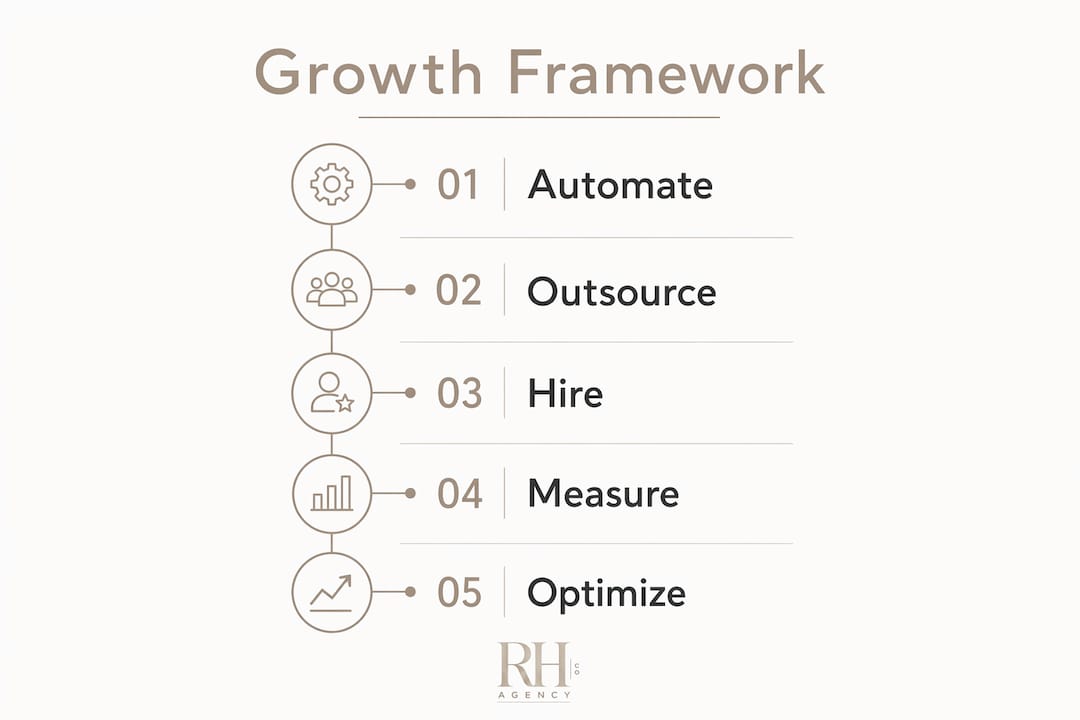
Managing business growth without overhead means scaling your operations through automation and outsourcing rather than adding costly full-time staff. The automate-outsource-hire framework is the most effective model for entrepreneurs who want to grow revenue without proportional increases in fixed costs. Medvi scaled to 250,000 customers in one year with only two employees by automating repeatable functions and using contractors for specialized work. Full-time hires cost $110,000 to $130,000 annually all-in, including benefits, payroll taxes, and onboarding. That fixed cost creates serious risk before your revenue can support it.
What operational functions can you automate to reduce overhead?
Automation is the first and highest-leverage move for any entrepreneur trying to manage expansion without overhead. Rule-based, repeatable tasks are the best candidates: content scheduling, customer support responses, invoice generation, lead follow-up sequences, and appointment booking. These functions consume hours every week but require no strategic judgment, which makes them ideal for AI-powered tools.

Founders using AI-native content tools like Monolit save 8 to 12 hours weekly and achieve three times the posting consistency with 40% higher engagement compared to manual execution. That time savings compounds quickly. Redirecting even eight hours per week toward client acquisition or product development is the equivalent of adding a part-time employee at zero cost.
Practical automation targets for small business owners include:
- Content creation and scheduling: Tools like Monolit handle social media automation at scale
- Customer support: AI chatbots resolve common queries without human intervention
- CRM workflows: Automated follow-up sequences, tagging, and pipeline updates
- Invoicing and billing: Platforms like QuickBooks and FreshBooks automate recurring billing and payment reminders
- Scheduling: Tools like Calendly eliminate back-and-forth coordination entirely
Pro Tip: Audit your weekly calendar before hiring anyone. If more than 30% of your time goes to tasks you could describe in a simple checklist, those tasks belong in an automation tool, not a job description.
The goal is not to automate everything blindly. Strategic decisions about your customer profile and messaging still require human judgment. Automate execution, not strategy.
How does outsourcing support growth without adding full-time staff?
Outsourcing covers the gap between what automation can handle and what requires genuine human expertise. Fractional specialists and contractors provide expert-level skills on demand without the fixed cost of full-time employees. Legal counsel, graphic design, paid media management, and tax preparation are the most common outsourced functions for growing small businesses.
The cost comparison is stark. A legal retainer runs $2,000 to $4,000 per month. A full-time in-house attorney costs $130,000 or more annually plus benefits. For most small businesses, the need for legal work does not justify that fixed commitment. The same logic applies to paid media, design, and financial advisory work.
Here is how outsourcing compares to full-time hiring across key dimensions:
| Function | Outsourced cost | Full-time cost | Best fit |
|---|---|---|---|
| Legal counsel | $2,000–$4,000/month retainer | $130,000+/year | Outsource until Series A |
| Graphic design | Project or retainer basis | $60,000–$80,000/year | Outsource for most SMBs |
| Paid media | 10–15% of ad spend | $70,000–$90,000/year | Outsource until $500K+ spend |
| Tax and accounting | $3,000–$8,000/year | $55,000–$75,000/year | Outsource indefinitely |
Managing outsourced teams efficiently requires clear scope documents, defined deliverables, and regular check-ins. Offshore staffing models extend this further by giving growing businesses access to skilled contractors at lower cost structures without sacrificing quality. The key is treating contractors like partners, not vendors. Give them context, not just tasks.
Pro Tip: Use a shared project management tool like Asana or ClickUp with every contractor from day one. Centralizing communication and deliverables prevents the coordination costs that erode the savings outsourcing is supposed to create.
When does a full-time hire actually make sense?
Full-time hiring is justified when a function requires daily presence, deep institutional knowledge, and continuity that no contractor can provide. The failure most entrepreneurs make is hiring prematurely, before revenue supports the fixed cost. Delay hiring until $1 million ARR, except for technical co-founders or roles core to product delivery.
Use this sequence to evaluate any potential hire:
- Can this task be automated? If yes, build the automation before considering a person.
- Can a contractor or fractional specialist handle it? If yes, outsource it and monitor quality for 90 days.
- Does this role require daily presence and institutional knowledge? If yes, and revenue supports it, hire.
- Does the coordination cost of outsourcing now exceed the cost of a hire? If yes, it is time to bring the role in-house.
The hidden cost most founders miss is what Leanpivot calls the coordination tax. As headcount grows, meetings, onboarding, and communication overhead grow disproportionately, often costing more than the salaries themselves. This is why the automate-outsource-hire hierarchy exists. Hiring is not a reward for growth. It is a last resort when other models stop working.
Pro Tip: Before making any full-time hire, calculate the true all-in cost: salary, payroll taxes, benefits, equipment, onboarding time, and management overhead. Then ask whether that same $110,000 to $130,000 could buy 12 months of fractional support across three specialized roles instead.
How do you build measurement systems that support lean growth?
Data-driven feedback loops are what separate businesses that scale efficiently from those that grow and then collapse under their own weight. Without proper attribution, you are spending money on marketing and operations without knowing what is working. That is not lean growth. That is guesswork with a budget.
Ascend grew ARR 38% to $27.6 million in six months using Claude Code to run campaigns, prospecting, and CRM automation without any dedicated growth hires. The foundation of that result was rebuilding their CRM around attribution, tracking every paying customer's channel origin and acquisition cost. That data told them exactly where to spend and where to stop.
Key measurement systems every lean business needs:
- CRM with source attribution: Every lead and customer tagged by acquisition channel from day one
- Customer acquisition cost by channel: Calculated monthly, not quarterly
- Revenue per contractor or tool: Understand what each outsourced function or automation tool generates relative to its cost
- Churn and retention metrics: Tracked automatically, not manually reviewed in spreadsheets
The ICP and messaging strategy must be defined by a human before any automation or AI tool touches execution. Skipping this step and jumping straight to paid media or automated outreach amplifies targeting mistakes at scale. Get the strategy right first. Then let the tools run it.
Key takeaways
Financially sustainable growth requires automating execution, outsourcing expertise, and hiring only when revenue and coordination costs make it unavoidable.
| Point | Details |
|---|---|
| Automate first | Target rule-based tasks like scheduling, invoicing, and content to reclaim 8 to 12 hours weekly. |
| Outsource expertise | Use fractional specialists for legal, design, and paid media instead of committing to fixed salaries. |
| Delay full-time hires | Avoid hiring until $1 million ARR unless the role is core to product delivery. |
| Build attribution systems | Track customer acquisition cost by channel from day one to eliminate wasted spend. |
| Own outcomes, not tasks | Shift your role from operator to orchestrator by building systems that run without your daily input. |
The orchestrator mindset is the real competitive advantage
I have worked with enough founders to know that the overhead problem is rarely a budget problem. It is a mindset problem. Most entrepreneurs default to hiring because it feels like progress. A new team member signals growth. It feels decisive. But what it actually does is add coordination weight before the business has the systems to absorb it.
The businesses I have seen scale most efficiently share one trait: the founder stopped thinking like an operator and started thinking like an orchestrator. They own outcomes. They do not do tasks. They build systems that run with minimal intervention, and they treat every new hire as a failure of that system rather than a milestone.
The orchestrator model is not about working less. It is about working on the right things. Setting customer profiles, refining messaging, evaluating which systems are underperforming. That is the work that compounds. Answering emails and scheduling calls does not.
The entrepreneurs who struggle with this framework are usually the ones who believe their business is too unique to systematize. It is not. Every business has repeatable functions. Finding them and removing yourself from them is the work. Everything else is just execution.
— Jessica
How The Right Hand Agency Co can help you grow lean
The strategies in this article work. They also require someone to set them up, manage the contractors, configure the CRM, and keep the systems running while you focus on growth. That is exactly what The Right Hand Agency Co does.
Our executive assistant services give you flexible, expert operational support without the fixed cost of a full-time hire. We also implement technology and automation systems that handle the repeatable work your business runs on. Whether you need CRM setup, workflow automation, project management, or day-to-day operational support, we provide the fractional capacity that lets you scale without adding headcount. If you are ready to grow without the overhead, we are the right partner to build it with you.
FAQ
What is the automate-outsource-hire framework?
The automate-outsource-hire framework is a cost-effective growth strategy where businesses automate repeatable tasks first, outsource specialized work second, and hire full-time employees only as a last resort. Medvi used this model to scale to 250,000 customers with just two employees.
When should a small business make its first full-time hire?
Most lean scaling experts recommend delaying full-time hiring until $1 million ARR, except for technical co-founders or roles directly tied to product delivery. Before that threshold, outsourcing and automation typically deliver better value per dollar.
Can AI tools really replace a growth team?
Yes, in many cases. Ascend grew ARR 38% to $27.6 million in six months using Claude Code for campaigns, prospecting, and CRM automation with no dedicated growth hires. The prerequisite is a clearly defined ICP and messaging strategy set by a human before automation runs execution.
What tasks should never be automated or outsourced?
Strategic decisions about your ideal customer profile, pricing, and core messaging require human judgment and should stay with the founder or a trusted senior advisor. Automating execution before getting strategy right amplifies mistakes rather than results.
How do fractional consultants differ from contractors?
Fractional consultants bring senior-level expertise on a part-time or project basis, often advising on strategy as well as execution. You can learn more about the types of part-time consultants available to small businesses and how each role supports growth without full-time overhead.