
TL;DR:
- Business process optimization involves making targeted, data-driven improvements to workflows to enhance speed, reduce costs, and ensure consistent results. It should be approached as an ongoing cycle, with a clear structure like DMAIC, rather than a one-time project, to sustain meaningful operational gains over time.
Most business owners assume that business process optimization means tearing everything down and rebuilding from scratch. It doesn't. Business process optimization is the discipline of making targeted, data-driven improvements to specific workflows so they run faster, cost less, and produce more consistent results. You don't need a full redesign. You need a clear method for finding where things slow down, fixing them, and making sure they stay fixed. This article walks you through exactly that.
Table of Contents
- Key takeaways
- What business process optimization actually means
- Goals and benefits of process optimization
- Frameworks and lifecycle of process optimization
- Best practices and pitfalls to avoid
- How optimization drives real operational results
- My take on why most optimization efforts stall
- How The Right Hand Agency Co can help
- FAQ
Key takeaways
| Point | Details |
|---|---|
| Targeted, not total redesign | Business process optimization improves specific workflows rather than overhauling entire operations from scratch. |
| BPO differs from BPM | BPM governs your overall process framework; BPO is the focused improvement work done within that framework. |
| Optimize before you automate | Automating a broken process amplifies the problem. Fix the workflow first, then apply automation. |
| DMAIC provides structure | The Define, Measure, Analyze, Improve, Control cycle gives you a repeatable method for lasting improvements. |
| Monitoring prevents regression | Gains fade without controls. The monitoring phase is what separates a one-time fix from a permanent improvement. |
What business process optimization actually means
Business process optimization (BPO) is the practice of identifying inefficiencies in existing workflows and making targeted changes to improve speed, quality, consistency, or cost. According to Gluu's process guide, the goal is to pinpoint exactly where workflows slow down or vary, then fix those specific points without disrupting what already works.
This is where a lot of business owners get confused. There are three related but distinct concepts worth separating:
- Business Process Management (BPM): The broader governance system that defines, documents, and oversees all your processes. Think of BPM as the operating system.
- Business Process Optimization (BPO): Targeted improvement work done within that system. BPO is the project you run to make a specific process better.
- Workflow Automation: A tool used to execute tasks within an already-optimized process. Automation is not optimization.
IBM describes optimization as a keystone of digital transformation, emphasizing that it requires structured approaches, not just technology. The distinction matters because many businesses skip straight to automation without fixing the underlying process first. That approach amplifies problems rather than solving them.
Understanding process efficiency starts with recognizing that your documented process and your actual process are often two different things. People adapt, shortcuts emerge, and the real workflow drifts from what the procedure manual says. Effective BPO starts by mapping what's actually happening, not what's supposed to happen.

Goals and benefits of process optimization
When business owners ask about the benefits of process optimization, the answer depends on what problem they're trying to solve. The most common goals fall into a few categories: reducing cycle time, cutting operational costs, improving output quality, and building the consistency needed to scale.
Here's what well-executed business process improvement typically delivers:
- Faster turnaround: Removing unnecessary approval steps or handoffs cuts the time it takes to complete a task.
- Lower costs: Eliminating redundant work and rework reduces labor and overhead without cutting headcount arbitrarily.
- Better quality: Standardized workflows produce more consistent results and fewer errors.
- Scalability: A process that works reliably at current volume can be scaled up without proportionally increasing staff.
- Competitive advantage: Businesses that operate with less friction can respond to clients and market changes faster than competitors who are still firefighting.
There's a risk worth naming here. Automating a broken workflow yields minimal real gains, according to Salesforce. If your invoicing process has three unnecessary approval steps, automating it just means those three unnecessary steps happen faster. Optimization must come before automation.
Pro Tip: Before you invest in any new software or automation tool, spend two weeks documenting how your team actually completes the process in question. You will almost always find at least one step that exists out of habit rather than necessity.
Frameworks and lifecycle of process optimization
Understanding how to optimize business processes requires more than good intentions. It requires a repeatable structure. The most practical way to think about this is as a four-stage continuous loop.
| Stage | What happens | Key question |
|---|---|---|
| Discovery | Map the actual current-state process | What is really happening, and where does it break down? |
| Analysis | Identify root causes of inefficiency | Why does this problem exist? |
| Implementation | Design and test improvements | What change will fix the root cause? |
| Monitoring | Track results and sustain gains | Are the improvements holding? |
Salesforce describes this lifecycle as a continuous loop where monitoring results feed directly back into discovery. That feedback loop is what makes optimization sustainable rather than a one-time event.
For teams that want a more structured methodology, DMAIC is the gold standard. It stands for Define, Measure, Analyze, Improve, and Control. Developed within the Lean Six Sigma framework, DMAIC guides data-driven problem solving through each phase with clear deliverables. The Define phase sets the scope and goals. Measure establishes your baseline. Analyze uncovers root causes. Improve tests and implements solutions. Control standardizes the fix and monitors for regression.
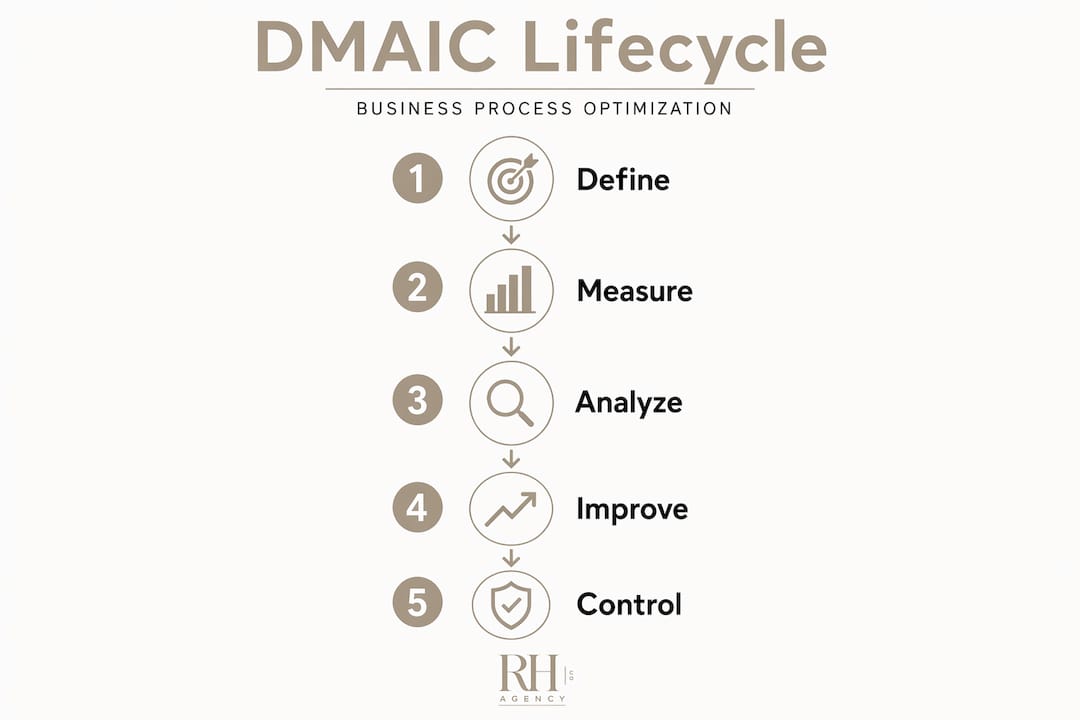
The Control phase deserves special attention. Most businesses treat it as paperwork. It isn't. The Control phase is the mechanism that prevents your team from drifting back to old habits once the project closes.
Pro Tip: You don't need to run a formal Lean Six Sigma program to use DMAIC. Even a simplified version of the five phases applied to a single workflow will produce better results than informal trial and error.
Best practices and pitfalls to avoid
The gap between businesses that see lasting results from process optimization and those that don't usually comes down to execution discipline. Here are the practices that separate successful efforts from wasted ones:
- Start with discovery that reflects reality. Map the process as it actually runs, not as it's documented. Interview the people doing the work.
- Set measurable goals before you change anything. "Faster" is not a goal. "Reduce invoice processing time from five days to two" is a goal.
- Fix the process before you automate it. Optimization precedes automation. Automation executes stabilized workflows. It doesn't fix unstable ones.
- Involve the people doing the work. Stakeholder buy-in is not a soft concern. Resistance from the team is the most common reason improvements don't stick.
- Use technology as an enabler, not the solution. Software supports an optimized process. It cannot replace the thinking required to design one.
- Monitor continuously. Build in regular checkpoints after implementation. Gains fade without controls.
The most damaging pitfall is treating optimization as a project with a finish line. Business workflow optimization is an ongoing discipline. Processes that worked well last year may need adjustment as your team grows, your client base shifts, or your tools change.
How optimization drives real operational results
The practical impact of business process improvement becomes clear when you look at specific scenarios. Consider a small professional services firm where the client onboarding process involves six people, four email threads, and a shared spreadsheet that three people update independently. The result is delays, duplicated work, and clients who feel like they're falling through the cracks.
Optimizing that workflow might mean consolidating intake into a single CRM, assigning clear ownership for each step, and removing two approval stages that exist only because no one ever questioned them. The outcome: onboarding time cuts in half, the team spends less time chasing status updates, and clients notice the difference immediately.
Optimization also makes delegation more effective. When a process is clearly defined and consistently followed, handing it off to an executive assistant or an operations support partner becomes straightforward. Ambiguous processes, on the other hand, create dependency on specific individuals and make delegation nearly impossible.
Technology integration plays a supporting role here. When you pair an optimized workflow with the right technology and systems, you get the compounding benefit of a clean process running on tools designed to support it.
My take on why most optimization efforts stall
I've worked with enough small and mid-sized businesses to see a clear pattern. The optimization effort starts strong. There's energy, a clear problem to solve, and real momentum. Then the implementation phase wraps up and everyone moves on. Six months later, the process has quietly drifted back to something close to what it was before.
The reason is almost always the same: the Control phase got skipped. Nobody set up the monitoring. Nobody assigned ownership of the ongoing checks. The improvement was real, but it wasn't protected.
What I've learned is that the most valuable thing you can do after implementing a change is to build in a 30-day and 90-day review. Not a formal audit. Just a deliberate check: is the process still running the way we designed it? If not, why not?
The other thing I'd push back on is the idea that optimization requires a dedicated team or a formal program. Some of the best process improvements I've seen came from a business owner sitting down with one team member and asking, "Walk me through exactly how you do this." That conversation alone surfaces more real bottlenecks than most process audits.
— Jessica
How The Right Hand Agency Co can help
If you've read this far and are thinking about which of your processes actually needs attention, that's exactly the right question to be asking.
At The Right Hand Agency Co, we work with business owners and executives to identify operational bottlenecks, design cleaner workflows, and put the right support structures in place so improvements actually hold. Whether that means executive assistant support to take execution off your plate, or operations consulting to map and fix the processes slowing your growth, we build around what your business actually needs. No full-time hires required. If you're ready to stop running in circles and start running a tighter operation, reach out and let's talk.
FAQ
What is business process optimization?
Business process optimization is the practice of making targeted improvements to specific workflows to increase speed, reduce cost, and improve quality. It focuses on fixing identifiable inefficiencies rather than redesigning entire operations from scratch.
How does BPO differ from business process management?
BPM is the governance framework that oversees all your processes, while BPO is the focused improvement work you do within that framework. Think of BPM as the system and BPO as the project.
Should I automate before or after optimizing a process?
Always optimize first. Automating a broken process speeds up the inefficiency without fixing it. Stabilize and improve the workflow, then apply automation to execute it consistently.
What is the DMAIC framework?
DMAIC stands for Define, Measure, Analyze, Improve, and Control. It is a five-phase Lean Six Sigma methodology that guides teams through data-driven process improvement with a built-in control mechanism to sustain gains over time.
How do I know which processes to optimize first?
Start with the processes that cause the most friction, delay, or rework. If your team spends significant time correcting errors, chasing approvals, or manually transferring information between systems, those are strong candidates for immediate attention.