
TL;DR:
- Practice management consulting involves a structured advisory process to improve revenue cycle, compliance, and operations alongside your team. It differs from outsourcing by empowering your practice through targeted recommendations and systems building rather than taking over functions entirely. A well-structured, KPI-driven engagement over approximately 90 days ensures measurable, lasting improvements and strategic growth.
Most business leaders who start looking into practice management consulting assume it means hiring someone to give generic advice or take over operations like an outsourcing partner. That assumption leads to misaligned expectations and wasted money. What is practice management consulting, really? It is a structured advisory and implementation process where specialists assess your practice's operations, revenue cycle, compliance posture, and growth strategy, then guide your team to real, measurable improvements. This article breaks down what that actually looks like in practice.
Table of Contents
- Key takeaways
- What practice management consulting entails
- How consulting improves operational efficiency
- Strategic benefits beyond daily operations
- Choosing the right consulting engagement
- My take on what actually works
- How The Right Hand Agency Co can support your next step
- FAQ
Key takeaways
| Point | Details |
|---|---|
| Consulting is not outsourcing | Consultants advise and implement alongside your team rather than replacing day-to-day operations. |
| Diagnosis before execution | The highest ROI comes from a structured diagnostic phase before any changes are recommended or made. |
| KPIs drive real results | Setting baseline metrics before engaging a consultant separates meaningful progress from busy work. |
| Scope is broader than most expect | Practice management covers revenue cycle, compliance, staffing, technology, and strategic planning. |
| Short projects outperform open retainers | Defined, deliverable-focused engagements produce clearer outcomes and stronger accountability. |
What practice management consulting entails
Practice management consulting evaluates a practice's business operations across revenue cycle, staffing, compliance, and strategic growth, then delivers recommendations and, in many cases, hands-on implementation support. The scope is wider than most leaders realize when they first start exploring it.
Here is what practice management services typically cover across a consulting engagement:
- Revenue cycle management: Coding reviews, payer contracting, denial analysis, and collections workflow
- Operations: Scheduling efficiency, patient flow, staff accountability, and role clarity
- Compliance: HIPAA audits, documentation reviews, and regulatory alignment
- Technology: EHR optimization, systems integration, and reporting infrastructure
- Strategic planning: Service line expansion, profitability analysis, and growth planning
One of the most misunderstood distinctions in this space is the difference between consulting and outsourcing. Consultants focus on empowering leadership with insights and tools rather than executing daily tasks. An outsourcing partner takes over a function entirely. A consultant works with your team to fix the systems and the people, then steps back. That distinction matters because it changes what success looks like and who owns it.
Engagement models typically follow three phases: diagnostic, recommendations, and execution. Engagements are structured as defined projects, often around 90 days, with discrete deliverables rather than open-ended retainers. This structure creates accountability and prevents the common failure mode where consulting work drags on without clear outcomes.
Pro Tip: Before signing any consulting agreement, ask the firm to outline exactly which deliverables you will receive at each phase. Vague agreements produce vague results.
How consulting improves operational efficiency
Operational inefficiency in a medical practice rarely comes from one broken thing. It usually comes from a pattern of disconnected processes that nobody has mapped end-to-end. This is where consulting for practice management creates real leverage.
Consultants conduct interviews, financial reviews, and workflow observations to build a prioritized action plan that ties operational problems to their financial and compliance causes. The most common pain points they surface include:
- Workflow bottlenecks where patients, paperwork, or billing tasks pile up at specific handoff points
- Staff accountability gaps where roles overlap or nobody owns a specific process outcome
- Revenue cycle failures buried inside the steps from eligibility verification through AR collections
- Rising overhead that grows faster than revenue because no one has analyzed cost drivers
- Inconsistent documentation that triggers payer denials and compliance exposure
Revenue cycle improvements alone can materially change a practice's financial performance. Consultants dissect the revenue cycle into what should happen versus what actually happens at each step, catching issues hidden in the handoffs between staff. A 30-day denial recovery project, for example, often surfaces months of recoverable revenue that the internal team simply did not have the bandwidth to pursue.
Pro Tip: Ask your consultant to document the "as-is" workflow before proposing any changes. If they skip this step, the recommendations will not stick because they will not address the actual process your team runs.

The operational improvements that last are not the ones that depend on one person doing things correctly every time. Sustainable improvement comes from systems-building, including workflow definitions, coaching, and measurement, not one-time reports. That is the difference between a practice that improves while the consultant is present and one that improves permanently.
Strategic benefits beyond daily operations
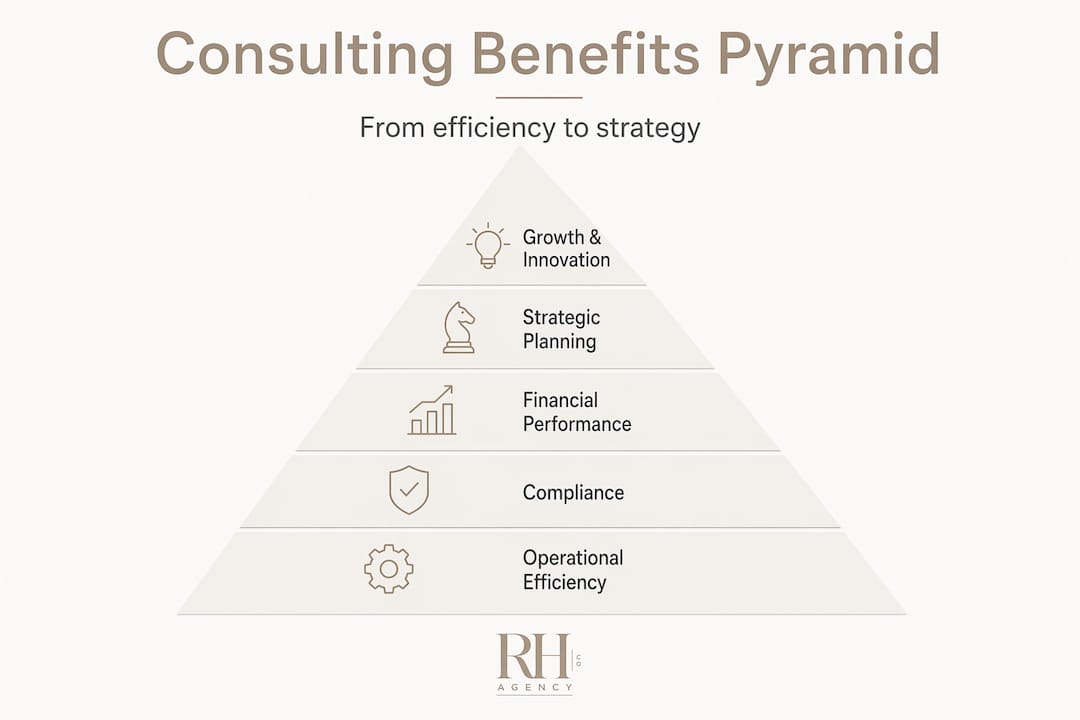
Operational efficiency is the foundation, but the benefits of practice management extend well into strategy and long-term financial health. Once the operational floor is stable, consultants shift focus to growth, positioning, and financial sustainability.
| Short-term fix | Long-term strategic benefit |
|---|---|
| Resolve coding errors | Build a compliant billing system that reduces future audit risk |
| Fill scheduling gaps | Design a patient flow model that supports service line growth |
| Address staff turnover | Create accountability structures and development paths that retain people |
| Renegotiate one payer contract | Build a payer contracting strategy across all carriers |
| Reduce denials this month | Implement denial tracking that prevents recurring issues |
Strategic planning support from a practice management consultant might include financial analysis to identify which service lines actually generate profit, modeling for new locations or providers, and guidance on mergers or acquisitions. Many practice leaders are surprised to find that their most profitable service line is not the one generating the most revenue. A consultant with financial modeling skills will surface that discrepancy quickly.
Payer contracting is another area where the strategic value becomes concrete. Negotiating rates without data on your cost structure and utilization patterns is negotiating blind. Consultants bring the analytical framework that turns those conversations into measurable financial wins. The clinic's long-term growth depends on this kind of structured, evidence-based approach rather than reactive decisions made under pressure.
Choosing the right consulting engagement
Selecting the right consulting engagement is as important as selecting the right consultant. A poorly structured engagement wastes time, creates dependency rather than capability, and rarely produces lasting change.
Here is what to look for and what to clarify before you commit:
- Diagnostic first. Starting with a diagnostic that maps workflow pain points to financial and compliance causes produces the highest ROI and avoids isolated fixes that do not address root causes.
- Defined deliverables. Avoid open-ended agreements. Every engagement should specify what you will receive, by when, and what success looks like in measurable terms.
- KPI baselines. Effective engagements set baseline KPIs before recommending changes so leadership can track whether improvements are real or cosmetic.
- Role clarity. Understand whether the consultant will train your team, manage execution alongside you, or serve purely in an advisory capacity. Interim management is a separate, explicit contract arrangement.
- References and track record. Practice management consulting firms vary significantly in their depth of expertise. Ask for references from practices similar to yours in size and specialty.
Good consulting engagement structure looks like a 90-day sprint with clearly defined phases. By week four you have the diagnostic. By week eight you have prioritized recommendations. By week twelve you have an implementation roadmap with ownership assigned to specific people on your team. That structure keeps momentum high and prevents the common failure of analysis without execution.
My take on what actually works
When I look at how consulting engagements go wrong, the pattern is almost always the same. The practice leader hires a consultant, receives a polished report, and then nothing changes because nobody owns the implementation. I have seen this play out repeatedly, and it is entirely avoidable.
In my experience, the difference between a consulting engagement that transforms a practice and one that produces a binder nobody reads comes down to two things: the clarity of the diagnostic and the discipline of the KPI framework. If you do not know your baseline numbers before you start, you cannot measure progress. And if you cannot measure progress, you cannot distinguish real improvement from activity that just feels productive.
The practices that get the most from consulting are the ones that treat the engagement as a leadership development process, not just a problem-solving exercise. The systems your consultant builds should outlast the engagement itself. If your practice only runs well when the consultant is in the room, something went wrong. That is the standard I would hold any consulting engagement to.
— Jessica
How The Right Hand Agency Co can support your next step
If you are ready to move from understanding practice management consulting to actually improving how your business operates, The Right Hand Agency Co works with practice owners and executives to implement the operational systems, workflows, and support structures that make consulting recommendations stick.

From executive assistant support that keeps your leadership focused on high-value decisions, to technology and systems integration that connects your tools and processes, The Right Hand Agency Co brings hands-on execution capacity to complement your consulting strategy. You get the operational infrastructure your practice needs without adding full time overhead. Explore our services and see how we support growing practices at every stage.
FAQ
What does practice management consulting include?
Practice management consulting covers revenue cycle management, compliance, staffing, operations, technology alignment, and strategic planning. Consultants assess your current state and guide implementation of improvements.
How is consulting different from outsourcing?
Consultants advise and work alongside your team to build better systems, while outsourcing partners take over specific operational functions entirely. The goal of consulting is to leave your practice more capable, not dependent.
How long does a practice management consulting engagement take?
Most engagements are structured as 90-day projects with defined phases covering diagnosis, recommendations, and implementation planning. Some practices extend into ongoing retainer support after the initial project.
How do I measure success from a consulting engagement?
Baseline KPIs set before the engagement begins are the benchmark for measuring real improvement. Track metrics like denial rate, days in AR, overhead ratio, and staff turnover to quantify outcomes.
What should I look for in practice management consulting firms?
Look for firms that lead with a diagnostic phase, set measurable KPIs from the start, and provide references from practices similar in size and specialty to yours. Avoid any firm that cannot clearly define what deliverables you will receive and when.