

Running a solo business without a real system behind it is like building a house without a blueprint. You know what needs to get done, but the moment three clients need something at once, everything starts to slip. If you want to set up project management solo business practices that actually hold up under pressure, you need more than a to-do list. 35% of solopreneurs report high stress levels compared to 26% of those with employees, and the gap almost always comes down to structure. This guide gives you that structure, step by step.
Table of Contents
- Key Takeaways
- Set up your project management solo business the right way
- Building your solo project management framework
- Common pitfalls when managing projects alone
- Measuring and improving your solo system
- My honest take on solo project management
- How Therhagency helps solo businesses run better
- FAQ
Key Takeaways
| Point | Details |
|---|---|
| Start simple, then scale | Build a minimal system first and add complexity only when your current setup breaks down. |
| Limit your active projects | Capping work at 5 to 7 active projects protects quality and reduces mental overload. |
| Weekly review is non-negotiable | A 10 to 20 minute Friday review keeps your solo system running without a team to hold you accountable. |
| Write tasks with precision | Vague tasks cause procrastination. Write every item as if briefing someone else to complete it. |
| Measure what matters | Track time saved and stress reduction, not just task completion, to know if your system is working. |
Set up your project management solo business the right way
Before you touch a single app or template, you need to get one thing straight: the goal is not to build the most sophisticated system. The goal is to build the one you will actually use. Most solo entrepreneurs fail here because they design for an idealized version of themselves rather than the real, distracted, deadline-juggling version.
The mindset that makes or breaks your setup
Adopt a philosophy of start minimal, iterate often. Your first version of this system should take no more than two hours to set up. If it takes longer, you are already over-engineering it. Over-engineering PM systems wastes more time managing tools than doing actual work, and that is a trap that catches smart, detail-oriented people the most.
Think of your system like a pilot's checklist, not a corporate project management office. It should reduce cognitive load, not add to it.
Essential tools for solo project management
You do not need ten apps. You need a short stack that covers three functions: capture, organize, and schedule.
- Capture tool: A single inbox where every task, idea, and commitment lands. This can be a digital app or a physical notebook, but it must be one place only.
- Organization tool: A project management app that lets you group tasks by project and context. Look for something with a board or list view, due dates, and basic tagging.
- Calendar: Your time commitment layer. Every task that has a deadline or a time block goes here.
| Tool type | What to look for | What to avoid |
|---|---|---|
| Task capture | Fast input, available on mobile | Apps that require setup before adding a task |
| Project organizer | Board view, tagging, due dates | Tools with steep learning curves |
| Calendar | Time blocking, reminders | Separate calendars for work and personal |
Pro Tip: Pick one tool in each category and commit to it for at least 90 days before switching. Tool hopping is one of the most common productivity traps for solo entrepreneurs.
Prepare your workspace by removing the friction that breaks focus. Close unused browser tabs, set up a dedicated folder structure on your desktop, and decide in advance when you will check messages versus when you will do deep work.

Building your solo project management framework
This is where your system comes to life. Follow these steps in order. Do not skip ahead.
- Create a unified inbox. Every task, client request, idea, and commitment goes into one place before it gets sorted anywhere else. This single habit alone prevents things from falling through the cracks.
- Organize by active projects. Group your tasks under 5 to 7 named projects. If you have more than seven active projects, you are already spread too thin. Limiting active projects to 5 to 7 is one of the clearest recommendations from project management research for solo operators.
- Apply a simple organizing framework. The PARA method (Projects, Areas, Resources, Archives) works well for freelancers and consultants. Projects are things with a deadline. Areas are ongoing responsibilities. Resources are reference material. Archives are completed or inactive items.
- Define your Daily Big Three. Each morning, choose three tasks that must get done that day. Not ten. Not five. Three. This forces prioritization and gives you a clear win condition for the day.
- Write tasks as instructions to your future self. Highly specific, actionable tasks prevent procrastination and confusion. Instead of "work on proposal," write "draft the pricing section of the Johnson proposal, 300 words, referencing the scope doc."
- Build a weekly review ritual. Every Friday, spend 10 to 20 minutes reviewing what got done, what did not, and what moves to next week. The weekly review habit is the single most important practice for maintaining solo project momentum.
One-page project plans
For each active project, keep a one-page document that covers the goal, the deadline, the three to five next actions, and any key dependencies. That is it. You do not need a Gantt chart. You need clarity.
- Goal: What does done look like?
- Deadline: Hard date or target date?
- Next actions: What are the very next physical steps?
- Dependencies: What or who are you waiting on?
Pro Tip: Solopreneurs using a unified workspace spend 40% less time on task-switching overhead. Keeping everything in one system, rather than scattered across email, sticky notes, and apps, is one of the highest-leverage moves you can make.
Common pitfalls when managing projects alone
Knowing the mistakes before you make them saves you weeks of frustration. Here are the ones that derail solo project management most often.
- Running too many projects at once. More than seven active projects degrades quality across the board. If a new project comes in, something else needs to pause or close.
- Vague task writing. "Follow up with client" is not a task. "Send the revised contract to Maria by 3 PM Thursday" is a task. The difference in execution is enormous.
- Ignoring client tracking. Poor client tracking causes solo professionals to lose significant revenue every year. Keep a simple "Client OS" that separates active clients from leads, and update it weekly.
- No buffer for urgent tasks. Reactive work is real. Budget 20 to 30% of your weekly capacity for urgent or unplanned tasks so that surprises do not blow up your entire plan.
- Skipping the weekly review. When you skip it once, you skip it again. Then your inbox fills up, deadlines sneak up, and the whole system collapses. Treat the review like a client meeting you cannot cancel.
"The system that gets used beats the perfect system that gets abandoned every single time. Build for consistency, not sophistication."
Pro Tip: AI agents can automate sprint planning and status reporting, which reduces coordination overhead significantly. Use AI for the repetitive administrative layer, but keep your judgment in charge of priorities.
Measuring and improving your solo system
Setting up your system is step one. Knowing whether it is working is step two. Most solopreneurs skip the measurement phase entirely, which means they keep tweaking things based on feelings rather than data.
Here are the metrics worth tracking:
- Hours reclaimed per week. Solopreneurs with structured systems reclaim 10 to 15 hours per week compared to those managing reactively. Track your time for two weeks before and after setup to see the difference.
- Task completion rate. What percentage of your Daily Big Three do you actually finish? Aim for 80% or higher.
- Stress level (self-rated). Rate your work stress on a 1 to 10 scale each Friday during your review. If the number is not trending down over 30 days, something in the system needs to change.
- Project on-time rate. How often do you hit your own deadlines? Below 70% signals that your estimates are off or your plate is too full.
| Metric | Target | Review frequency |
|---|---|---|
| Hours reclaimed | 10 to 15 per week | Monthly |
| Daily Big Three completion | 80% or higher | Weekly |
| Stress level (1 to 10) | Trending down | Weekly |
| Project on-time rate | 70% or higher | Monthly |
When and how to upgrade your system matters too. Do not add new tools or complexity until your current setup is running smoothly for at least 90 days. If a specific pain point keeps showing up in your weekly reviews, that is your signal to address it with a targeted fix, not a full system overhaul.
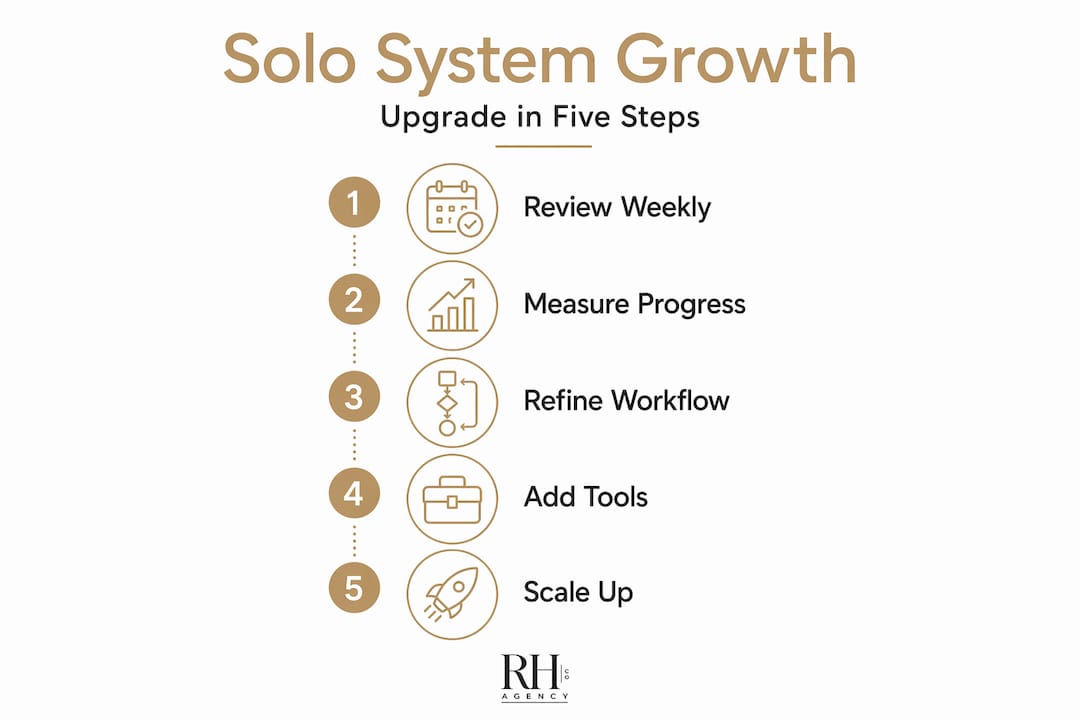
Pro Tip: Your weekly sprint review is the real leverage point for solo momentum. It is not just a habit. It is the feedback loop that tells you whether your system is serving you or slowing you down.
My honest take on solo project management
I have worked with dozens of solo entrepreneurs and freelancers who came to us completely buried. And almost every single one of them had the same problem: they were using three to five different apps, none of them talking to each other, with tasks living in email threads, voice memos, and mental notes. The system was not the problem. The lack of one system was.
What I have learned is that the weekly review is the most underrated practice in solo business. People treat it like optional homework. It is not. It is the moment you step out of the work and look at the work. Without it, you are always reacting.
I have also seen how quickly people reach for automation and AI as a way to avoid the harder work of deciding what actually matters. AI can absolutely reduce your admin load. But it cannot tell you which client relationship to prioritize or when to say no to a project. That judgment is yours.
My honest advice: start with a single notebook and a calendar. Add one digital tool only when the notebook breaks down. Build the habit before you build the system. Most people do it backwards, and that is why most people's systems do not last past week three.
— Jessica
How Therhagency helps solo businesses run better
Running a solo business does not mean doing everything alone. At Therhagency, we work specifically with business owners who need real operational support without the overhead of a full-time hire.

If project management is eating your time, our executive assistant services can take over task coordination, client follow-ups, and scheduling so you can stay focused on the work that actually grows your business. We also set up the technology and systems layer for you, from workflow automation to client tracking, so your PM setup runs without constant maintenance. And if social media and marketing are on your plate too, we handle that as well. Solo does not have to mean stretched thin. Reach out to Therhagency and let us build the back end of your business with you.
FAQ
How do I start solo project management from scratch?
Start by creating a single inbox for all tasks and ideas, then organize them under no more than seven active projects. Add a weekly review ritual and a daily prioritization habit before adding any tools.
What are the best tools for solo project management?
You need three tools: a fast capture app, a project organizer with board or list views, and a calendar for time blocking. Commit to one tool in each category for at least 90 days before evaluating alternatives.
How many projects can a solo entrepreneur handle at once?
Research recommends capping active projects at 5 to 7 to avoid quality degradation from context switching. If a new project comes in, pause or close an existing one first.
How do I avoid burnout when managing projects alone?
Budget 20 to 30% of your weekly capacity as a buffer for reactive tasks, write highly specific tasks to reduce decision fatigue, and never skip your weekly review. Structure prevents burnout more reliably than willpower does.
How do I know if my solo project management system is working?
Track your weekly task completion rate, project on-time rate, and self-rated stress level during your Friday review. If stress is not trending down within 30 days, adjust the system rather than pushing harder.